

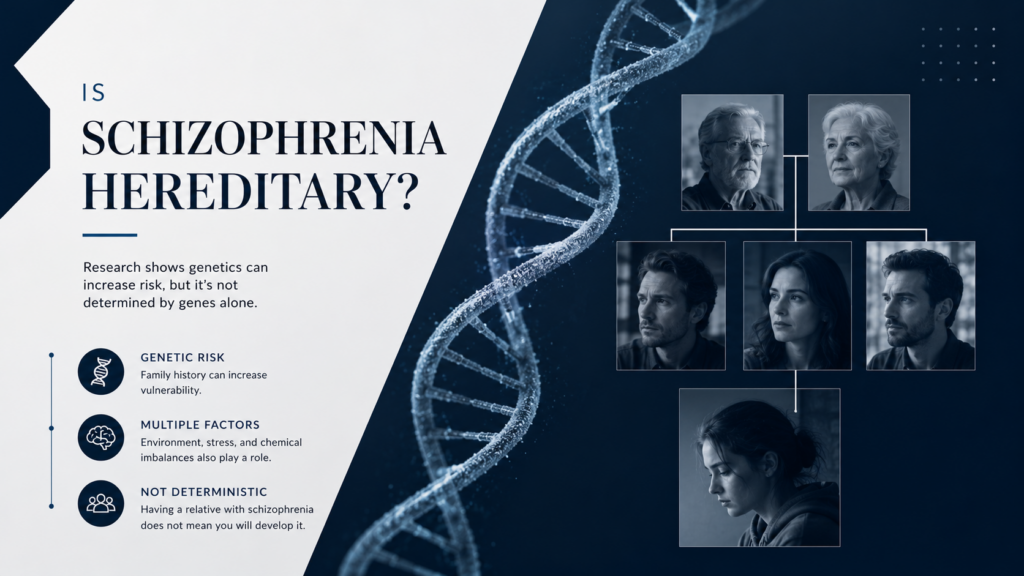
Is schizophrenia hereditary? Many people ask this when a parent, sibling, or other family member has been diagnosed with schizophrenia. The answer is yes, schizophrenia can run in families, but it is not caused by one gene alone. A person may have a higher risk because of genetic factors, environmental factors, or both. If you are worried about symptoms, family history, or the risk of developing schizophrenia, Revival Mental Health offers support through schizophrenia treatment in Orange County.
Schizophrenia is a serious mental health disorder that affects how a person thinks, feels, and sees the world. It can cause psychosis, false beliefs, hearing or seeing things that are not there, and trouble knowing what is real. It can also cause negative symptoms, such as low motivation, less emotion, and pulling away from family members.
Is Schizophrenia Hereditary?
Schizophrenia is considered highly heritable, which means genetics can play a strong role. But hereditary does not mean certain. A person can have family history and never develop schizophrenia. A person can also be diagnosed with schizophrenia even when no close family members have the illness.
Researchers believe the exact causes of schizophrenia are complex. The disorder often comes from genetic and environmental factors working together. This means genes may raise the risk, while life events, brain development, stress, childhood trauma, pregnancy problems, or birth complications may also affect the chance of developing schizophrenia.
What Does Hereditary Mean?
Hereditary means a health condition can be passed down through family genes. Genes are small instructions in the body that help control development, the brain, and health. When scientists study schizophrenia, they look at genetic variants that may affect brain development and mental illness risk.
But schizophrenia is not like some diseases that come from one clear gene change. There is no single “schizophrenia gene.” Instead, research shows that many common variants, rare deletions, and certain genes may affect schizophrenia risk at a genetic level.
Family History and Schizophrenia Risk
Family history is one of the clearest risk factors for schizophrenia. If a close family member has schizophrenia, a person may have an increased risk compared to the general population.
How Family Members May Be Affected
Risk can be higher when schizophrenia affects:
A parent
A brother or sister
Identical twins
More than one close family member
The risk of schizophrenia is not the same for every family. A person’s genetic risk can change based on how closely related they are to the affected person, how many relatives are diagnosed, and what environmental risk factors are present.
Schizophrenia Compared to the General Population
The general population has a lower risk of developing schizophrenia than people with a strong family history. But even with family history, most people do not develop the disorder. This is why doctors do not diagnose schizophrenia based on family history alone.
A full mental health check is needed if symptoms of schizophrenia appear. A trained mental health provider will look at symptoms, onset age, daily function, substance use, medical history, and family history.
Genetic Risk Factors for Schizophrenia
Genetic risk factors are gene-related traits that may raise the chance of developing schizophrenia. Scientists have identified many genetic variants linked with schizophrenia, but each one often has a small effect on its own.
Common Variants
Common variants are small genetic differences that many people have. Some common variants may raise schizophrenia risk a little. When many of these variants are present together, the genetic risk may become higher.
Rare Deletions
Rare deletions happen when a small piece of genetic material is missing. Some rare deletions may increase risk for schizophrenia and other psychiatric disorders. These are not common, but they help researchers understand the genetic basis of the illness.
Certain Genes and Brain Development
Certain genes may affect how the brain grows, how nerve cells talk, and how the brain handles stress. This matters because schizophrenia is linked to brain development. Some changes may begin before symptoms appear, even during pregnancy or early life.
What Twin Studies Tell Us
Twin studies help researchers explain the role of genetics. Identical twins share almost all of the same genes. If schizophrenia were caused by genes alone, then if one identical twin had schizophrenia, the other twin would always have it too.
But that is not what research shows. The other twin may have a higher risk, but they may never develop schizophrenia. This gives strong evidence that genetic and environmental factors both matter.
Why Identical Twins Matter
Identical twins help scientists separate genetic factors from environmental factors. These studies show that schizophrenia is highly heritable, but not fully genetic. Environment, exposure, stress, health, pregnancy complications, and life events may also affect risk.
Environmental Factors That May Raise Risk
Environmental factors are things outside of genes that may affect health and brain development. These do not always cause schizophrenia on their own. But they may raise the risk in people who already have genetic risk factors.
Environmental Risk Factors
Environmental risk factors may include:
Childhood trauma
High stress during development
Pregnancy complications
Birth complications
Exposure to infection before birth
Substance use during teen years or young adulthood
Social isolation
Severe ongoing stress
These risk factors do not mean a person will develop schizophrenia. They only mean the risk may be higher.
Childhood Trauma and Mental Health
Childhood trauma can affect mental health and brain development. Trauma may include abuse, neglect, violence, or unsafe living situations. For some young people with genetic risk, trauma may add stress to the brain and body.
Support, therapy, safe relationships, and early treatment can help lower the harm caused by trauma.
Pregnancy and Birth Complications
Pregnancy and birth complications may also be linked to a higher risk of developing schizophrenia later in life. These may include low oxygen during birth, early birth, infection during pregnancy, or poor fetal growth.
These complications do not mean a child will be diagnosed with schizophrenia. They are only possible risk factors. Most children with birth complications do not develop schizophrenia.
When Does Schizophrenia Usually Start?
Schizophrenia often starts in late adolescence or early adulthood. This means symptoms may begin in the teen years, 20s, or early 30s. Onset age can be different for each person.
Early Onset Schizophrenia
Early onset schizophrenia means symptoms begin before adulthood. This is less common, but it can happen. Young people may show changes in school, friendships, mood, sleep, or behavior before clear psychosis appears.
Signs may include:
Pulling away from family
Trouble thinking clearly
Strong fear or suspicion
Hearing voices
Seeing things others do not see
Drop in school performance
Less interest in daily life
Flat emotions
Strange speech or behavior
Early support is important. The sooner symptoms are treated, the better the chance of improving daily life.
Symptoms of Schizophrenia
Symptoms of schizophrenia can affect thoughts, feelings, and actions. They often fall into three groups: positive symptoms, negative symptoms, and thinking symptoms.
Positive Symptoms
Positive symptoms are added experiences that other people may not have. These can include:
Hallucinations
Delusions
Psychosis
Confused speech
Unusual behavior
Negative Symptoms
Negative symptoms are losses in normal emotion or function. These may include:
Low motivation
Less facial expression
Speaking less
Pulling away from others
Trouble feeling joy
Poor self-care
Negative symptoms can be hard for family members to understand. A person may look lazy or uncaring, but these symptoms are part of the disorder.
Thinking Symptoms
Schizophrenia can affect thinking and memory. A person may have trouble focusing, planning, learning, or making choices. These symptoms can make school, work, and relationships harder.
Schizophrenia, Bipolar Disorder, and Other Psychiatric Disorders
Schizophrenia shares some risk factors with other psychiatric disorders, including bipolar disorder. Both conditions can involve genetics, brain changes, mood changes, and sometimes psychosis.
But schizophrenia and bipolar disorder are not the same disorder. Bipolar disorder mainly affects mood, energy, and activity levels. Schizophrenia mainly affects reality testing, thinking, and perception. A mental health provider can help explain the difference and make the right diagnosis.
What Researchers Have Learned About Genetics
Researchers have made major progress in understanding schizophrenia genetics. Groups like the Psychiatric Genomics Consortium and the Schizophrenia Working Group study large groups of patients and control groups. A control group is made of people who do not have the disorder being studied.
Psychiatric Genomics Consortium Research
The Psychiatric Genomics Consortium helps scientists study the genetic architecture of schizophrenia. Genetic architecture means the full pattern of genes, common variants, rare deletions, and genetic risk that may be involved.
Research has identified many areas of the genome linked with schizophrenia. This helps scientists learn more about the brain, development, and possible future treatment targets.
Systematic Review and Meta Analysis
A systematic review looks at many studies on the same topic. A meta analysis combines data from several studies to find stronger evidence. These tools help researchers understand what is more likely to be true across many patients, families, and study groups.
The evidence shows that schizophrenia has a genetic basis, but genes do not explain everything. Environmental risk factors also matter.
Can Genetic Testing Predict Schizophrenia?
At this time, genetic testing cannot clearly tell if a person will develop schizophrenia. This is because the disorder is linked to many genes, each with small effects. A person may have genetic risk and never become ill.
Genetic testing may be useful in rare cases when a doctor is checking for a known deletion or another medical condition. But for most people, genetic testing is not used to diagnose schizophrenia.
A diagnosis is based on symptoms, health history, mental health evaluation, and how long symptoms have been present.
Can Schizophrenia Be Prevented?
There is no sure way to prevent schizophrenia. But early care may lower harm and improve outcomes. People at higher risk can protect mental health by getting support early.
Steps That May Help Lower Risk
Helpful steps may include:
Avoiding drugs that can trigger psychosis
Getting help for trauma
Managing stress
Sleeping enough
Building healthy family support
Treating anxiety, depression, or other mental illness early
Talking to a mental health professional if warning signs appear
These steps do not remove all risk, but they can support brain health and emotional stability.
What To Do If Schizophrenia Runs in Your Family
If schizophrenia runs in your family, try not to panic. Family history means higher risk, not a guaranteed diagnosis. It is helpful to learn the signs, watch for changes, and get support early.
Watch for Early Warning Signs
Early warning signs may include:
Hearing or seeing things others do not
Strong fear that others are trying to harm you
Trouble knowing what is real
Confused thoughts
Social withdrawal
Drop in school or work
Less interest in hygiene
Unusual beliefs
Major sleep changes
If these signs appear, a mental health evaluation can help explain what is happening.
How Schizophrenia Is Diagnosed
Schizophrenia is diagnosed by a trained mental health provider. The provider may ask about symptoms, family history, health, substance use, and daily life. They may also check for other causes, such as medical problems or drug use.
A person may be diagnosed with schizophrenia when symptoms last long enough and affect daily function. The provider may also look at whether symptoms are caused by another disorder, such as bipolar disorder, major depression with psychosis, or another medical condition.
Treatment for Schizophrenia
Schizophrenia treatment can help people manage symptoms and improve daily life. Treatment often works best when it includes medical care, therapy, family support, and life skills.
Common Treatment Options
Treatment may include:
Antipsychotic medication
Individual therapy
Family education
Group support
Case management
Help with school or work
Crisis planning
Support for substance use if needed
The goal of treatment is not only to reduce symptoms. It is also to help people build safety, trust, routine, and hope.
How Family Members Can Help
Family members can play an important role in recovery. Schizophrenia can be scary and confusing for everyone involved. Calm support can make a big difference.
Helpful Ways to Support a Loved One
Family members can help by:
Learning about schizophrenia
Speaking in a calm voice
Avoiding blame
Helping with appointments
Watching for relapse signs
Encouraging treatment
Creating a safe home setting
Getting support for themselves too
Families should also know when to get emergency help. If a person may hurt themselves or someone else, call emergency services right away.
Why Early Treatment Matters
Early treatment can help reduce the effect of psychosis on the brain, relationships, school, work, and family life. The longer symptoms go untreated, the harder recovery may become.
Early care may help patients understand symptoms, stay connected to treatment, and reduce future crises. It can also help families learn how to respond in a safe and caring way.
Final Answer: Is Schizophrenia Hereditary?
Yes, schizophrenia can be hereditary. Genetic factors can raise the risk of developing schizophrenia, especially when there is family history. But genes are not the whole story. Environmental factors, childhood trauma, birth complications, pregnancy issues, stress, and brain development may also play a role.
Schizophrenia is a complex disorder. It is not caused by one gene, one parent, or one life event. The best way to respond is to watch for symptoms, get help early, and seek treatment from trained mental health providers.
FAQs
Is schizophrenia hereditary from mother or father?
Schizophrenia can be linked to genes from either side of the family. It is not only passed from the mother or only from the father. A person may have genetic risk factors from one or both parents, but this does not mean they will develop schizophrenia.
What is the risk of schizophrenia if a parent has it?
A person with a parent diagnosed with schizophrenia has a higher risk than the general population. But the risk is not 100%. Many people with a parent who has schizophrenia never develop the disorder.
Can schizophrenia skip a generation?
Yes, schizophrenia risk can appear to skip a generation. This can happen because many genes and environmental factors are involved. Some family members may carry genetic risk but never show symptoms.
Are identical twins always both diagnosed with schizophrenia?
No. Identical twins share almost all of the same genes, but if one twin has schizophrenia, the other twin does not always develop it. This shows that environmental factors and life experiences also matter.
Can childhood trauma cause schizophrenia?
Childhood trauma alone does not always cause schizophrenia. But it may be one environmental risk factor, especially for people who already have genetic risk. Trauma support and early mental health care can help protect long-term health.