

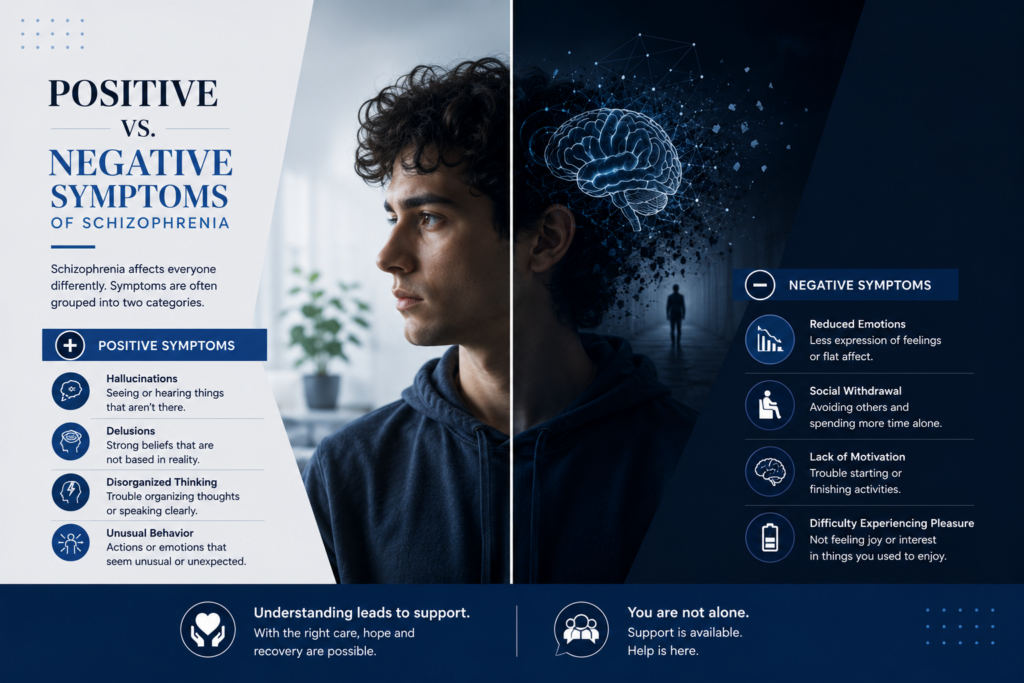
The positive vs negative symptoms of schizophrenia can affect how a person thinks, feels, speaks, and acts. Positive symptoms include experiences added to a person’s normal life, such as hallucinations and delusions. Negative symptoms involve abilities or behaviors that have become reduced, such as motivation, speech, emotion, and social interest.
Understanding these differences can help families notice changes and seek schizophrenia treatment in Orange County before symptoms cause greater problems with safety, health, work, school, or relationships.
What Are Positive and Negative Symptoms of Schizophrenia?
Schizophrenia is a serious mental health condition that can change a person’s thoughts, senses, emotions, and behavior. Symptoms are often placed into three main groups:
Positive symptoms
Negative symptoms
Cognitive symptoms
The words “positive” and “negative” do not mean good and bad. Positive symptoms are experiences that are added to a person’s usual way of thinking or sensing the world. Negative symptoms are normal abilities that have become weaker or are missing.
For example, hearing a voice that is not there is a positive symptom. Losing the drive to shower, cook, or talk with friends is a negative symptom.
A person may have symptoms from both groups at the same time. The number, type, and strength of symptoms can also change over time.
What Are Positive Symptoms of Schizophrenia?
Positive symptoms change how a person understands reality. These symptoms may make it hard to know what is real and what is not.
The main positive symptoms of schizophrenia include:
Hallucinations
Delusions
Disorganized speech
Disorganized or unusual behavior
These symptoms are sometimes called psychotic symptoms. They may come and go, or they may last for longer periods.
Hallucinations
Hallucinations happen when a person hears, sees, smells, tastes, or feels something that other people do not.
Hearing voices is one of the most common types of hallucination in schizophrenia. A person may hear one voice or several voices. The voices may speak to the person, talk about them, criticize them, or tell them to do something.
Other hallucinations may include:
Seeing people, lights, or shapes
Feeling someone touch the body
Smelling odors that are not present
Feeling insects crawling on the skin
Tasting something without eating it
Hallucinations can feel completely real to the person having them. Arguing or saying, “That is not real,” may increase fear or distress. A calmer response is to say that you do not hear or see the same thing, but you understand that the experience feels real to them.
Delusions
Delusions are strong beliefs that are not based on reality. The person may continue to believe them even when other people offer facts that show the belief is not true.
Common delusions may involve believing that:
Someone is following or watching them
Other people want to harm them
Television shows contain secret messages
They have special powers or an important mission
Their thoughts are being controlled
Someone can hear or steal their thoughts
A loved one has been replaced by another person
A delusion is more than a mistake or unusual opinion. It is a fixed belief that can shape the person’s choices and behavior. Delusions involving danger or persecution may cause strong fear, hiding, anger, or mistrust.
Disorganized Speech and Thinking
Schizophrenia may make it hard for a person to organize their thoughts. This problem can appear in the way they speak.
A person may:
Jump quickly between unrelated topics
Give answers that do not match the question
Stop speaking in the middle of a sentence
Repeat certain words or ideas
Use made-up words
Speak in a way that is hard to follow
Disorganized speech does not mean the person is trying to be confusing. Their thoughts may feel scattered, blocked, or difficult to place in order.
Disorganized or Unusual Behavior
Positive symptoms can also affect movement and behavior. The person may act in ways that do not fit the setting or situation.
Examples include:
Wearing clothes that do not match the weather
Becoming very restless or agitated
Following unusual routines
Having trouble completing basic tasks
Making repeated movements
Holding the body in one position
Responding very little to people or surroundings
Severe movement problems may be linked to catatonia. Catatonia requires professional evaluation because it can affect a person’s ability to move, speak, eat, drink, or respond.
What Are Negative Symptoms of Schizophrenia?
Negative symptoms involve a loss or reduction of normal emotional and behavioral abilities. They may be less noticeable than hallucinations or delusions, but they can greatly affect daily life.
Negative symptoms often include:
Low motivation
Reduced emotional expression
Limited speech
Loss of pleasure
Social withdrawal
These symptoms can make it hard to work, attend school, care for personal needs, build relationships, or follow a daily routine.
Reduced Motivation
Reduced motivation is also called avolition. A person may want to complete a task but feel unable to begin or continue it.
This may affect:
Showering and brushing teeth
Cleaning the home
Preparing meals
Paying bills
Going to work or school
Attending appointments
Taking prescribed medication
Following hobbies or goals
Reduced motivation is not the same as laziness. It is a symptom that can interfere with the brain’s ability to plan, start, and complete an activity.
Breaking a task into small steps may help. Instead of saying, “Clean your room,” a family member might say, “Let’s put these clothes in the basket first.”
Flat or Limited Emotional Expression
A person with flat emotional expression may show little emotion through their face, voice, or body language.
They may:
Speak in a quiet or flat tone
Make little eye contact
Show few facial expressions
Use fewer hand movements
Appear emotionally distant
Respond less to happy or sad news
This does not always mean the person feels no emotion. They may feel love, fear, sadness, or joy inside but have trouble showing it outwardly.
Family members should avoid assuming that the person does not care. Calm questions and patient communication can give the person more time to express what they feel.
Limited Speech
Limited speech is sometimes called alogia. A person may speak less often or use very short answers.
For example, they may answer a detailed question with one or two words. They may also take a long time to respond because it is difficult to find words or organize thoughts.
Limited speech can make conversations feel one-sided. It may also be mistaken for anger, dislike, or a lack of interest.
Using simple questions can help. Give the person time to answer without rushing them or asking several questions at once.
Loss of Pleasure
A reduced ability to feel pleasure is called anhedonia. Activities that were once enjoyable may no longer feel rewarding.
The person may lose interest in:
Music
Food
Exercise
Games
Art
Dating
Family events
Spending time with friends
Loss of pleasure is also seen in depression, so a mental health professional must look at the person’s full set of symptoms before making a diagnosis.
Social Withdrawal
Social withdrawal happens when a person avoids friends, family, or community activities.
They may spend long periods alone, stop answering messages, or avoid conversations. This can happen because social contact feels tiring, confusing, frightening, or unrewarding.
Withdrawal may also be connected to hallucinations, delusions, anxiety, depression, or fear of being judged. The cause may be different for each person.
Support should be gentle. Offering a short walk or quiet meal may feel more manageable than a crowded event.
What Is the Main Difference Between Positive and Negative Symptoms?
The main difference is whether an experience has been added or a normal ability has been reduced.
Positive symptoms add unusual thoughts, beliefs, senses, speech, or behaviors. Negative symptoms reduce motivation, communication, pleasure, emotional expression, and social connection.
Examples include:
Hearing voices is a positive symptom.
Speaking very little is a negative symptom.
Believing others are sending secret messages is a positive symptom.
Showing little emotion is a negative symptom.
Acting in a confused or unusual way is a positive symptom.
Losing interest in friends is a negative symptom.
A person can have both types. Someone may hear voices while also having little motivation to eat, shower, or leave home.
Are Negative Symptoms the Same as Depression?
Negative symptoms and depression can look alike, but they are not always the same.
Both may cause:
Low energy
Social withdrawal
Reduced speech
Loss of interest
Trouble completing tasks
Less emotional expression
Depression often includes sadness, guilt, hopelessness, or thoughts of death. A person with negative symptoms may not report feeling sad. Instead, they may describe feeling empty, disconnected, or unable to begin tasks.
Medication side effects, substance use, anxiety, sleep problems, and untreated positive symptoms can also look like negative symptoms. A complete psychiatric and medical evaluation is important.
What Are Cognitive Symptoms of Schizophrenia?
Positive and negative symptoms are not the only symptoms of schizophrenia. Cognitive symptoms affect thinking, attention, memory, and decision-making.
A person may have trouble:
Paying attention
Remembering instructions
Understanding new information
Planning several steps
Making decisions
Solving everyday problems
Following a conversation
Cognitive problems can affect work, school, medication routines, and independent living. They may remain even when hallucinations or delusions improve.
Clear schedules, written reminders, simple directions, skills training, and structured support may make daily tasks easier.
Which Schizophrenia Symptoms Are Harder to Treat?
Positive symptoms often respond more clearly to antipsychotic medication. Hallucinations, delusions, and severe disorganization may become less frequent or less intense.
Negative symptoms can be harder to treat because several problems may cause them. A provider may need to consider depression, medication effects, active psychosis, substance use, sleep, isolation, physical health, and the person’s environment.
Treatment may include:
Antipsychotic medication
Individual therapy
Family education
Social skills training
Cognitive behavioral therapy
Supported work or education
Help building daily routines
Treatment for substance use
Physical health care
Treatment should be based on the person’s symptoms, goals, needs, and preferences. Many people can improve their daily functioning and take part in work, school, relationships, and community life with ongoing care.
When Should Someone Seek Professional Help?
Professional help is important when changes in thinking, emotions, speech, or behavior begin to affect daily life.
Warning signs may include:
Hearing or seeing things others do not
Strong beliefs that others want to cause harm
Confused or hard-to-follow speech
Severe fear or suspiciousness
A major drop in personal hygiene
Pulling away from loved ones
Not eating or drinking enough
Missing work or school
Being unable to complete basic tasks
Sudden or unsafe behavior
Early care matters. Delays between the start of psychosis and treatment may lead to poorer health and functioning over time.
Call emergency services when there is an immediate risk of harm, severe confusion, threatening behavior, an inability to meet basic needs, or thoughts of suicide.
How Can Families Support a Loved One?
Families can help by staying calm, learning about symptoms, and encouraging professional care.
Helpful steps include:
Listen without judging.
Speak in a calm, clear voice.
Avoid arguing about hallucinations or delusions.
Focus on the person’s fear or distress.
Reduce noise and other stimulation.
Offer simple choices.
Help with meals, sleep, and appointments.
Encourage treatment without using shame.
Create a plan for future crises.
Take threats of harm seriously.
Family support does not replace treatment. It can help the person feel safer and make it easier to remain connected with care.
Why Understanding These Symptoms Matters
Knowing the difference between positive and negative symptoms can help families explain what they are seeing to a mental health provider.
Hallucinations and delusions may be easier to notice because they involve clear changes in reality. Negative symptoms may be mistaken for laziness, rudeness, or a lack of caring.
Both groups of symptoms are real parts of schizophrenia. Both deserve compassion, assessment, and treatment.
Revival Mental Health provides structured support for adults experiencing schizophrenia symptoms. Treatment can focus on symptom control, daily living skills, healthy routines, emotional support, medication management, and long-term stability.
Frequently Asked Questions
What are the five main negative symptoms of schizophrenia?
The five common negative symptoms are reduced motivation, limited emotional expression, limited speech, reduced pleasure, and social withdrawal. A person may have one, several, or all of these symptoms.
Are hallucinations positive or negative symptoms?
Hallucinations are positive symptoms because they add a sensory experience that is not normally present. They may involve hearing, seeing, smelling, tasting, or feeling something that others do not.
Is paranoia a positive symptom of schizophrenia?
Paranoia is usually linked to positive symptoms. It may appear as a delusion that other people are watching, following, judging, or planning to harm the person.
Can a person have both positive and negative symptoms?
Yes. A person may experience hallucinations or delusions while also having low motivation, limited speech, flat emotional expression, and social withdrawal. Symptoms may change in type and strength over time.
Do negative symptoms mean someone does not care?
No. Negative symptoms can make it hard for a person to show emotions, speak, begin tasks, or connect with other people. The person may still care deeply even when their face, voice, or behavior does not show it.