

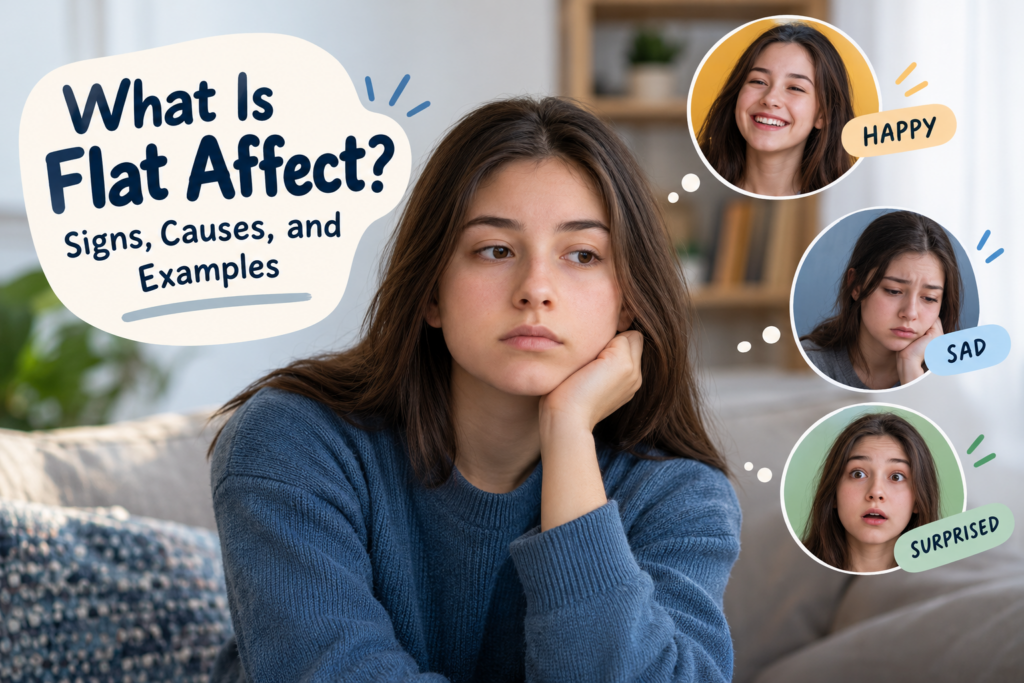
Flat affect is when a person shows very little emotion through their face, voice, or body language. They may look calm or show no facial expression, even when they feel strong emotions inside. Flat affect can occur with mental health conditions, brain disorders, and certain medical problems.
A person with flat affect may seem distant, quiet, or hard to read. However, this does not always mean they feel nothing.
Learning about flat affect can help you spot changes in emotional expression and know when to seek support. At Revival Mental Health, individuals can explore mental health treatment options for symptoms that affect their daily lives.
What Is Flat Affect?
Flat affect is a term used in mental health care to describe a major loss of outward emotional expression. The word “affect” means how a person shows feelings to others.
Most people show emotions through smiling, frowning, laughing, crying, or changing their tone of voice. Someone with flat affect may show very few of these signs.
For example, a person may receive exciting news but show no smile. They may hear something sad but keep the same facial expression.
Flat affect affects how emotions are shown, not always how emotions are felt.
A person may still feel happy, sad, worried, or excited inside. Their face and voice may simply not show those feelings.
What Does Flat Affect Look Like?
Common signs of flat affect include:
Little or no facial expression
A voice that sounds flat or monotone
Limited smiling or laughing
Very little change in body language
Reduced eye contact in some people
Few emotional reactions during conversations
A blank or neutral facial expression
Limited changes in tone when discussing emotional topics
These signs can vary from person to person. Some people show almost no emotion, while others show small changes.
A flat expression alone does not mean someone has a mental health disorder. A trained healthcare professional must look at other symptoms and the person’s usual behavior.
What Are the Signs and Symptoms of Flat Affect?
Flat affect can change how someone communicates with family, friends, and coworkers. The signs are often easier to notice during emotional situations.
1. Limited Facial Expressions
A person may rarely smile, frown, or raise their eyebrows. Their face may look the same during happy, sad, or stressful moments.
This can make it hard for others to understand how they feel.
2. Monotone Speech
Someone with flat affect may speak in a voice that does not change much.
Their voice may sound quiet, even, or lacking in emotion. They may use the same tone when sharing good news or talking about something upsetting.
3. Reduced Emotional Reactions
A person may not show an expected emotional response.
For example, they may remain expressionless when receiving a gift or hearing upsetting news.
This does not prove they do not care.
4. Limited Body Language
People often use hand movements, posture, and facial cues to show feelings.
Someone with flat affect may use fewer gestures or show little movement during conversations.
5. Difficulty Showing Feelings
A person may understand their emotions but struggle to express them.
They may say they feel happy while showing no smile or excitement.
This gap between inner feelings and outward expression is one of the main features of flat affect.
What Causes Flat Affect?
Flat affect is a symptom, not a mental health diagnosis on its own. It can have several possible causes.
Schizophrenia and Related Disorders
Flat affect is often linked to schizophrenia, a mental health condition that can affect thinking, emotions, and behavior.
It is considered a negative symptom of schizophrenia. Negative symptoms involve a reduction in normal abilities or behaviors.
Other negative symptoms may include:
Reduced motivation
Limited speech
Less interest in social activities
Difficulty showing pleasure
Reduced interest in daily tasks
Not everyone with schizophrenia experiences flat affect. Its severity can also change over time.
Depression
Some people with major depressive disorder show reduced emotional expression.
Severe depression can make a person appear withdrawn, quiet, or less responsive to things they once enjoyed.
Depression may also cause emotional numbness, low energy, and loss of interest in activities.
However, a person with depression does not always have flat affect.
Parkinson’s Disease
Parkinson’s disease affects movement and certain brain functions.
It can cause reduced facial movement, sometimes called facial masking.
A person may look expressionless because their facial muscles do not move as easily.
Facial masking can resemble flat affect, but the causes may be different.
Neurological Conditions
Some brain injuries and neurological disorders can affect emotional expression.
Damage to brain areas involved in movement, communication, or emotional control may change how a person shows feelings.
A healthcare professional may check for neurological causes when symptoms appear suddenly or occur with other physical changes.
Medication Effects
Some medications may reduce emotional expression or make people feel less emotionally responsive.
These effects can sometimes resemble flat affect.
If symptoms begin after a medication change, speak with the prescribing healthcare professional. Do not stop taking medication without medical guidance.
Flat Affect vs. Emotional Numbness: What’s the Difference?
Flat affect and emotional numbness may look similar, but they describe different experiences.
Flat affect means a person shows little emotion on the outside. Emotional numbness means a person feels little or no emotion on the inside.
A person can experience one without the other. They can also happen together.
Flat Affect: Reduced Outward Expression
Someone with flat affect may feel happy when seeing a loved one but show little excitement.
Their emotions may still be present, even though other people cannot easily see them.
Emotional Numbness: Reduced Inner Feelings
Emotional numbness involves feeling disconnected from emotions.
A person may describe feeling empty, distant, or unable to experience happiness or sadness.
Emotional numbness can occur with depression, trauma-related conditions, or high levels of stress.
Key Differences Between Flat Affect and Emotional Numbness
| Flat Affect | Emotional Numbness |
|---|---|
| Reduced outward emotional expression | Reduced inner emotional experience |
| May still feel strong emotions | May struggle to feel emotions |
| Often noticed by other people | Often described by the person |
| May affect facial expressions and voice | May cause feelings of emptiness or disconnection |
| Can occur with psychiatric or neurological conditions | Can occur with depression, trauma, and other conditions |
Understanding this difference helps mental health professionals choose the right evaluation and treatment approach.
What Are Examples of Flat Affect in Everyday Life?
Flat affect may be easier to understand through real-life examples.
Example 1: Receiving Good News
A person learns they received a promotion at work.
They feel proud but respond with a quiet “That’s good” and show almost no facial expression.
Example 2: Talking About a Sad Event
Someone discusses the loss of a family member.
They speak in a steady voice without visible sadness, even though they feel grief inside.
Example 3: Spending Time With Friends
A group of friends laughs during a funny movie.
One person enjoys the movie but does not smile or laugh much.
Example 4: Attending a Family Celebration
A person attends a birthday party and enjoys being there.
However, they show little excitement, rarely smile, and speak with limited changes in tone.
These examples do not prove someone has flat affect. Personality, culture, stress, and communication style can also influence emotional expression.
Flat Affect vs. Blunted Affect
Mental health professionals may use several terms to describe reduced emotional expression.
Flat affect and blunted affect are closely related, but they are not exactly the same.
What Is Blunted Affect?
Blunted affect means a person shows less emotional expression than expected.
Their emotional reactions are reduced but still noticeable.
For example, someone may give a small smile after hearing good news instead of showing a stronger reaction.
How Is Flat Affect Different?
Flat affect describes a more severe reduction in visible emotion.
A person may show almost no change in facial expression, voice, or gestures.
Both symptoms can appear in mental health or neurological conditions.
Doctors may also describe restricted affect, which means emotional expression is limited in range.
How Is Flat Affect Diagnosed?
There is no single blood test or scan that diagnoses flat affect.
Mental health professionals usually identify it through observation, interviews, and a review of symptoms.
Mental Health Evaluation
A psychiatrist, psychologist, or other qualified clinician may assess:
Facial expressions
Tone and rhythm of speech
Body language
Emotional reactions
Mood and personal feelings
Changes in daily functioning
Medical and medication history
The clinician may compare what the person says they feel with how they express those feelings.
Ruling Out Other Causes
A healthcare professional may also look for depression, schizophrenia, neurological problems, medication effects, or other possible causes.
Medical testing may be recommended if physical or neurological symptoms are present.
An accurate diagnosis matters because treatment depends on the underlying cause.
Can Flat Affect Be Treated?
Flat affect may improve with treatment, depending on what is causing it. There is no single treatment that works for everyone.
The goal is to address the underlying condition and improve daily functioning.
Mental Health Treatment
When flat affect occurs with a mental health disorder, treatment may include psychotherapy, medication management, and ongoing psychiatric care.
Treatment may help with related symptoms such as depression, social withdrawal, or reduced motivation.
Medication Management
A psychiatrist may review current medications and check whether side effects could be contributing to reduced emotional expression.
Medication changes should always be guided by a qualified prescriber.
Social Skills and Communication Support
Some people benefit from support that helps them communicate feelings and build stronger social connections.
Therapy may focus on conversation skills, emotional awareness, and everyday interactions.
Support From Family and Friends
Family members can help by avoiding assumptions about what someone feels.
A person who rarely smiles may still enjoy spending time with loved ones.
Patience, open communication, and respect can help reduce misunderstandings.
When Should You Seek Help for Flat Affect?
Consider speaking with a mental health professional if reduced emotional expression is new, persistent, or affecting daily life.
Signs that an evaluation may help include:
A sudden or lasting change in facial expressions
Withdrawal from family or friends
Trouble communicating feelings
Reduced motivation or interest in activities
Changes in speech or behavior
Symptoms of depression or psychosis
Difficulty managing work, school, or relationships
If reduced facial movement appears suddenly with weakness, facial drooping, or trouble speaking, seek emergency medical care. These can be signs of a stroke or another urgent condition.
Getting Mental Health Support at Revival Mental Health
Living with flat affect can make communication and relationships more difficult. People may misunderstand your reactions or assume you do not care.
At Revival Mental Health, individuals can seek professional support for mental health symptoms that affect emotional expression, communication, and daily functioning.
A mental health evaluation can help identify possible causes and determine which level of care may be appropriate.
If you or someone you love is experiencing reduced emotional expression along with other mental health symptoms, reaching out for professional guidance is an important first step.
Frequently Asked Questions About Flat Affect
1. What does flat affect mean in mental health?
Flat affect means a person shows very little emotion through facial expressions, voice, or body language. They may appear expressionless even when they experience emotions internally. It can occur with mental health and neurological conditions.
2. Can someone with flat affect still feel emotions?
Yes. People with flat affect may still feel happiness, sadness, fear, love, and excitement. The main difference is that they show fewer outward signs of those emotions. Flat affect does not automatically mean someone lacks feelings.
3. Is flat affect a sign of schizophrenia?
Flat affect can be a negative symptom of schizophrenia. However, it can also occur with depression, neurological conditions, and other medical problems. Flat affect alone is not enough to diagnose schizophrenia.
4. What is the difference between flat affect and emotional numbness?
Flat affect involves reduced outward emotional expression. Emotional numbness involves feeling disconnected from emotions internally. A person with flat affect may still feel strong emotions, while someone experiencing emotional numbness may struggle to feel them.
5. Can flat affect go away?
Flat affect may improve when its underlying cause is treated. Some people notice changes with mental health care, medication adjustments, or support for neurological conditions. Improvement depends on the cause, symptom severity, and individual response to treatment.
Understanding Flat Affect and Emotional Expression
Flat affect is a noticeable reduction in how a person shows emotions. It can affect facial expressions, speech, body language, and social interactions.
Although someone may appear emotionally distant, they may still experience strong feelings inside.
Understanding the difference between flat affect and emotional numbness can help reduce misunderstandings and encourage people to seek appropriate care.
If changes in emotional expression are affecting everyday life, a professional mental health evaluation can help identify possible causes and next steps.