

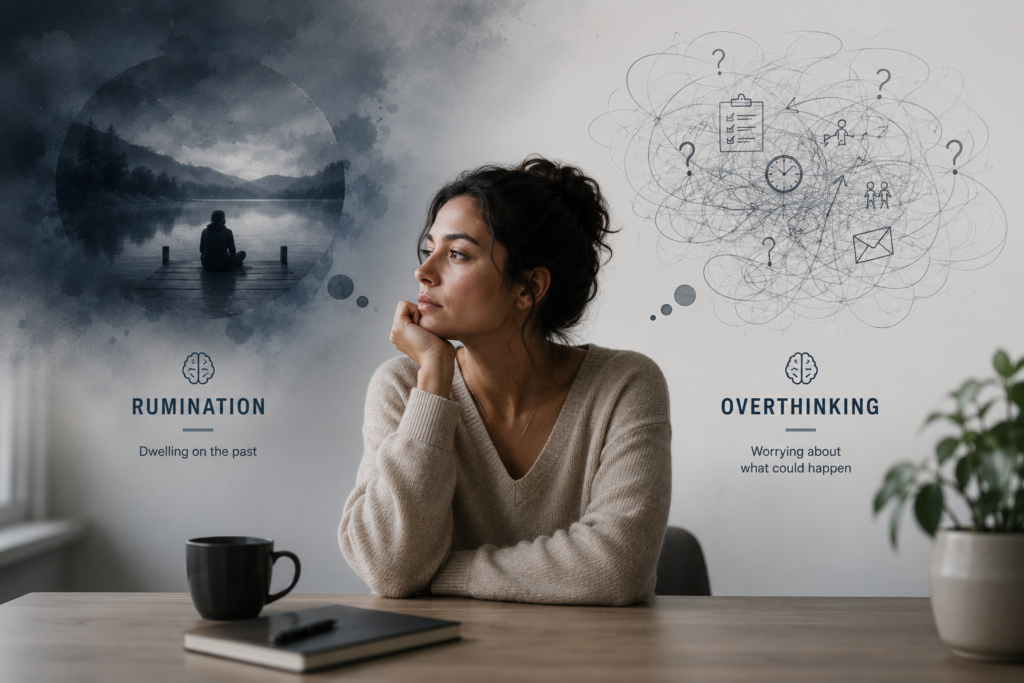
Understanding rumination vs overthinking can help you make sense of thoughts that feel hard to control. Both can leave your mind feeling tired and stuck. However, they are not always the same. Rumination often pulls your mind back to past pain, mistakes, regrets, or failures. Overthinking may focus more on current choices or what could happen next.
If these thought patterns are making daily life harder, learning more about mental health treatment can help you understand when extra support may be useful.
What Is Rumination?
Rumination is a pattern of thinking about the same negative event or feeling again and again.
A person may replay a mistake, argument, breakup, embarrassing moment, or painful memory. They may keep asking themselves why something happened or what they should have done differently.
This is sometimes called mental rumination or repetitive negative thinking.
What Does Mental Rumination Feel Like?
Rumination can feel like your mind is stuck on repeat.
You may think:
“Why did I say that?”
“I should have done something different.”
“Why does this always happen to me?”
“What is wrong with me?”
“I can’t believe I made that mistake.”
You may know that thinking about the event is not helping, but stopping can still feel difficult.
Some people describe the experience as, “I can’t stop thinking about mistakes I made.”
That pattern is one of the main signs that a thought process may be rumination rather than useful problem solving.
What Is Overthinking?
Overthinking means spending too much time analyzing a situation, choice, problem, or possible outcome.
Unlike rumination, overthinking does not always focus on something that already happened.
It may involve decisions happening right now or events that could happen in the future.
What Does Overthinking Feel Like?
A person who is overthinking may ask:
“What if I make the wrong choice?”
“What if something goes wrong?”
“Should I choose option A or option B?”
“What will people think?”
“What if I regret this later?”
Thinking through a choice can be healthy. Overthinking becomes a problem when the thinking goes in circles without helping you make a decision or take action.
Rumination vs Overthinking: The Main Difference
The biggest difference between rumination vs overthinking is often what your mind is focused on.
Rumination usually looks backward.
Overthinking may focus on the present or future.
Rumination Is Often Past-Focused
Rumination often centers on things that have already happened.
A person may replay:
Past mistakes
Arguments
Rejection
Embarrassing moments
Regrets
Loss
Perceived failures
The mind keeps searching for a different answer even though the event cannot be changed.
Overthinking Is Often Present- or Future-Focused
Overthinking commonly happens when you are trying to make a decision or predict what might happen.
For example, you may spend hours thinking about whether to take a new job, have a difficult conversation, start a relationship, or make another important choice.
You may feel like more thinking will finally make you certain.
Instead, each answer may create another question.
Rumination vs Overthinking and Problem Solving
Healthy problem solving has a goal.
Rumination and overthinking often do not.
Healthy Problem Solving Leads to Action
Problem solving may sound like:
“I made a mistake. What can I do differently next time?”
This thought looks at the problem and then moves toward an answer.
For example, you might apologize, make a plan, ask for help, or change your behavior.
Rumination Keeps Replaying the Problem
Rumination may sound like:
“Why did I make that mistake? Why am I always like this?”
There may be no clear action at the end.
Instead of solving the problem, the person stays focused on the pain connected to it.
Overthinking Can Delay Decisions
Overthinking may look productive because you are analyzing many different possibilities.
However, too much analysis can make it harder to choose.
You may keep looking for a perfect answer that does not exist.
This can lead to indecision, stress, and mental exhaustion.
Why Do People Ruminate?
There is not one cause of rumination.
People may ruminate when they are under stress, dealing with painful emotions, or trying to understand something difficult.
Rumination can also appear alongside depression.
Rumination and Depression
Depression can affect thoughts, emotions, energy, sleep, and interest in daily activities.
Someone experiencing depression may become focused on past problems, personal failures, guilt, or feelings of worthlessness.
This can create a cycle.
A painful thought may lower a person’s mood. A lower mood may then make negative thoughts easier to focus on.
People experiencing ongoing sadness, loss of interest, low energy, or repetitive negative thoughts may benefit from learning about depression treatment.
Why Do People Overthink?
Overthinking often grows from uncertainty.
The brain wants to know what will happen and how to avoid problems.
But many parts of life cannot be fully controlled.
Overthinking and Anxiety
Anxiety often involves worry about possible threats, problems, or negative outcomes.
A person may constantly prepare for what could go wrong.
They may ask themselves questions such as:
“What if I fail?”
“What if I embarrass myself?”
“What if something bad happens?”
Overthinking may feel like a way to stay prepared. However, thinking through every possible outcome can increase anxiety instead of reducing it.
When worry begins affecting sleep, work, relationships, or everyday activities, learning about anxiety treatment may be helpful.
Can Rumination and Overthinking Happen Together?
Yes.
A person can experience both rumination and overthinking.
For example, imagine someone who believes they performed poorly during a work meeting.
First, they may ruminate:
“I sounded foolish. I should not have said that.”
Then they may begin overthinking the future:
“What if my boss thinks I am bad at my job? What if I get fired? What should I say tomorrow?”
The thinking moves from a past event to future worry.
This type of repetitive negative thinking can become exhausting when it continues for hours or days.
Signs Rumination May Be Affecting Your Mental Health
Everyone thinks about past experiences sometimes.
Rumination becomes more concerning when it begins interfering with normal life.
Common Signs of Mental Rumination
Possible signs include:
Replaying mistakes for long periods
Feeling unable to move past a negative event
Thinking about regrets every day
Becoming more upset the longer you think
Having trouble sleeping because of past events
Struggling to focus on work or school
Pulling away from other people
Feeling hopeless about past choices
The key question is whether the thinking is helping you learn or simply keeping you stuck.
Signs Overthinking May Be Affecting Your Mental Health
Overthinking can also interfere with daily functioning.
Common Signs of Excessive Overthinking
You may notice:
Constantly questioning your choices
Asking many people for reassurance
Spending hours researching simple decisions
Imagining many worst-case outcomes
Delaying decisions because you fear making a mistake
Losing sleep because your mind will not slow down
Feeling mentally exhausted
Avoiding choices completely
Some people may also experience physical signs of anxiety, such as muscle tension, restlessness, or feeling on edge.
How to Stop Rumination
Stopping rumination does not mean forcing yourself to never think about the past.
Instead, the goal is to notice when thinking has stopped being useful.
Ask Whether the Thought Is Helping
Try asking:
“Is this thought helping me solve something?”
If the answer is no, your mind may be ruminating rather than problem solving.
Turn the Thought Into an Action
If there is something you can change, choose one small step.
For example:
“I regret what I said, so I will apologize tomorrow.”
Once you have identified an action, continuing to replay the event may no longer be useful.
Shift Your Attention
Activities that require attention can sometimes interrupt repetitive thinking.
Examples include:
Taking a walk
Calling someone you trust
Exercising
Cleaning
Cooking
Reading
Listening to music
Doing a hobby
The goal is not to hide from emotions. It is to stop feeding a thought loop that is no longer helping.
How to Stop Overthinking
Overthinking often improves when you move from endless analysis to a reasonable decision.
Set a Time Limit for Decisions
Small choices usually do not need hours of thought.
Give yourself a reasonable amount of time to decide.
Once that time is over, make the best choice you can with the information available.
Accept That You Cannot Know Everything
Overthinking often comes from wanting certainty.
But no decision comes with a guarantee.
Learning to accept some uncertainty may make decisions feel less overwhelming.
Focus on What You Can Control
Ask yourself:
“What can I actually do right now?”
You may not be able to control every future outcome.
You can control your next step.
Rumination vs Overthinking: When Should You Get Help?
Occasional rumination or overthinking is common.
Professional support may be worth considering when these patterns happen often or begin affecting your ability to function.
Consider Support When Repetitive Thinking Affects Daily Life
You may want to speak with a mental health professional if you:
Spend hours trapped in negative thoughts
Cannot focus because of worry
Feel depressed most days
Avoid important decisions
Have ongoing sleep problems
Struggle at work or school
Pull away from family or friends
Feel unable to control your thoughts
Notice your symptoms getting worse
A mental health professional can look at the full picture instead of focusing on one symptom.
How Depression and Anxiety Treatment Can Help
Rumination and overthinking are thought patterns, not personal failures.
Treatment may focus on helping people recognize unhelpful thinking habits and develop healthier ways to respond.
Therapy Can Help Change Thought Patterns
Therapy may help a person notice when thoughts are becoming repetitive.
Treatment may also help with:
Understanding emotional triggers
Building coping skills
Challenging negative beliefs
Making decisions
Managing stress
Improving emotional awareness
Reducing avoidance
Building healthier daily routines
The right approach depends on the person’s symptoms, history, needs, and goals.
Treatment Should Address the Whole Person
Someone who frequently ruminates may also experience sadness, guilt, low motivation, or loss of interest.
Someone who overthinks may experience worry, tension, fear, or trouble relaxing.
Because symptoms can overlap, a complete mental health assessment can help identify what may be contributing to the problem.
Rumination vs Overthinking: Key Takeaway
The difference between rumination vs overthinking often comes down to direction.
Rumination usually looks backward. It may involve repeatedly thinking about mistakes, regrets, negative experiences, or perceived failures.
Overthinking often looks at the present or future. It may involve excessive analysis, uncertainty, decisions, and possible outcomes.
Both can become forms of repetitive negative thinking when the mind keeps going in circles without reaching a useful answer.
If thoughts are interfering with sleep, relationships, work, school, or daily functioning, professional mental health support may help you understand the cause and build healthier thinking patterns.
Frequently Asked Questions
Is rumination the same as overthinking?
No. Rumination usually involves repeatedly thinking about negative experiences from the past. Overthinking often involves analyzing current decisions or worrying about future outcomes. A person can experience both at the same time.
Is rumination a sign of depression?
Rumination can occur with depression, especially when thoughts focus on guilt, regret, failure, hopelessness, or negative views of yourself. Rumination alone does not confirm that someone has depression. A mental health professional can evaluate other symptoms.
Is overthinking a sign of anxiety?
Overthinking can happen with anxiety because anxiety often causes people to focus on uncertainty and possible problems. Someone may analyze many future outcomes in an attempt to feel safer or more prepared.
Why can’t I stop thinking about mistakes?
If you can’t stop thinking about mistakes, your brain may be trying to understand what happened or prevent the same problem from happening again. When this thinking becomes repetitive without leading to a solution, it may be mental rumination.
When does repetitive thinking become a mental health concern?
Repetitive thinking may become a concern when it happens often, causes strong emotional distress, keeps you from sleeping, affects relationships, prevents you from making decisions, or interferes with work, school, or everyday life. A mental health professional can help determine whether depression, anxiety, stress, or another concern may be contributing.