
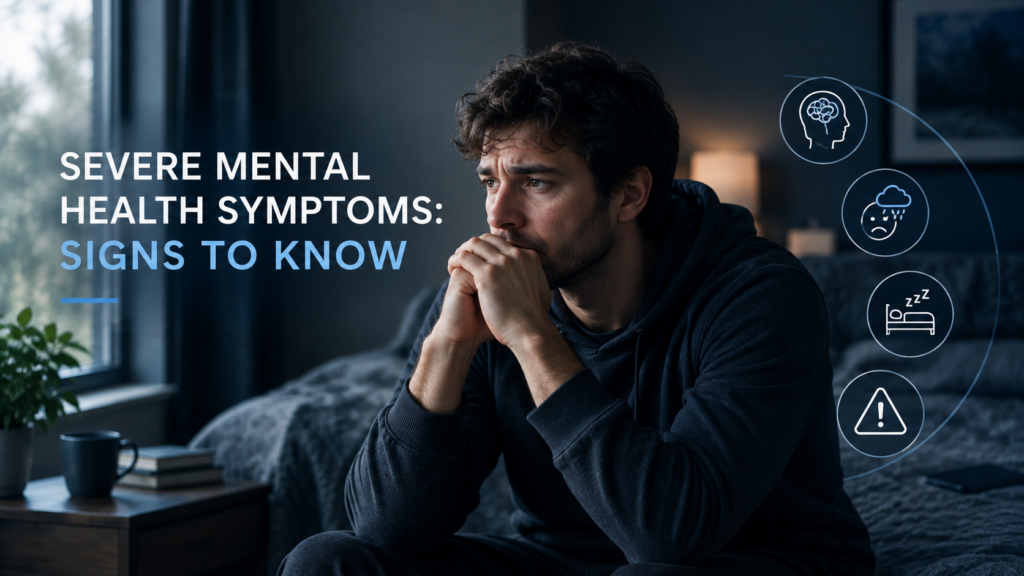
Mental health symptoms can change over time. Stress, anxiety, depression, trauma, or other conditions may start as problems that feel manageable. But symptoms can become more serious when they begin to affect basic parts of daily life.
Understanding severe mental health symptoms can help you know when it may be time to seek more support. At Revival Mental Health, mental health treatment can focus on both symptoms and how well a person can function, stay safe, care for themselves, and connect with others.
What Are Severe Mental Health Symptoms?
Severe mental health symptoms are emotional, behavioral, or thinking problems that strongly affect daily functioning.
Severity is not based on one symptom alone. Mental health professionals may look at how symptoms affect a person’s ability to:
Go to work or school
Keep up with personal hygiene
Eat regular meals
Sleep
Maintain relationships
Leave the house
Take prescribed medication
Make safe decisions
Understand what is real
Complete basic daily activities
Protect their own safety
A person does not need to have every problem on this list for their mental health to be serious.
The main question is often: How much are the symptoms changing the person’s ability to live safely and function each day?
What Are the Signs Mental Health Is Getting Worse?
The signs mental health is getting worse may look different for each person. Some changes happen slowly. Others can appear within days.
Friends or family members may notice the changes before the person experiencing them does.
Work or School Performance Starts to Decline
A sudden drop in work or school performance can be a sign of worsening mental health symptoms.
A person may:
Call out often
Miss deadlines
Forget important tasks
Make unusual mistakes
Stop responding to messages
Have trouble focusing
Lose a job because they cannot function
One difficult week does not always mean there is a serious mental health problem. Concern may be greater when the problems continue or become more severe.
For example, depression may make it hard to get out of bed. Severe anxiety may make a person unable to enter the workplace. Mania may affect judgment or lead to risky choices.
Personal Hygiene Becomes Difficult
Changes in hygiene can also show that symptoms are affecting daily functioning.
Someone may stop:
Showering
Brushing their teeth
Changing clothes
Washing their hair
Doing laundry
Cleaning their living space
This does not mean a person is lazy.
Severe depression, psychosis, trauma symptoms, and other mental health problems can make even simple tasks feel hard or confusing.
When someone can no longer care for basic physical needs, a professional assessment may be important.
Changes in Eating Can Signal More Serious Symptoms
Mental health can affect appetite and eating habits.
Some people may eat much less than usual. Others may eat much more. A person may also forget to eat or stop caring whether they have food available.
Signs of concern may include:
Skipping most meals
Large changes in appetite
Noticeable weight changes
Lack of energy caused by poor eating
Difficulty buying or preparing food
Believing food is unsafe without a reasonable cause
A major change in eating becomes especially important when physical health begins to suffer.
Severe Sleep Problems Can Affect Daily Functioning
Sleep and mental health are closely connected.
A person with worsening mental health symptoms may sleep almost all day or be unable to sleep for long periods.
Possible warning signs include:
Staying awake most of the night
Sleeping through much of the day
Going days with very little sleep
Being unable to wake up for responsibilities
Having disturbing nightmares
Becoming confused because of sleep loss
Very little sleep can sometimes occur during a manic episode. Severe insomnia can also make anxiety, depression, paranoia, and emotional control worse.
Major sleep changes should be taken seriously when they are affecting safety, judgment, or the ability to function.
Relationships May Begin to Break Down
Mental health symptoms can change how a person connects with family, friends, and partners.
They may start pulling away from everyone around them.
Other changes can include:
Frequent arguments
Increased anger
Distrust of people they normally trust
Avoiding calls or messages
Ending relationships suddenly
Believing loved ones are trying to harm them
Becoming extremely dependent on another person
Conflict by itself does not prove that someone has a severe mental health condition.
However, major changes across several relationships can be one clue that the person’s emotional or thinking patterns have changed.
Leaving the House May Become Extremely Difficult
Some people experiencing serious symptoms slowly stop going outside.
They may avoid:
Stores
Work
Medical appointments
Social events
Family gatherings
Public places
Driving
Anxiety, panic disorder, agoraphobia, depression, paranoia, and trauma-related symptoms can all make leaving home difficult.
Concern increases when someone becomes almost completely isolated or cannot leave home even for important needs.
At that point, symptoms may be limiting basic independence.
Medication Adherence May Become a Concern
People prescribed psychiatric medication may sometimes miss a dose. An occasional mistake does not always signal a major problem.
A more serious concern may develop when someone repeatedly stops medication because symptoms affect their judgment.
Examples include:
Forgetting medication for many days
Refusing medication because of paranoid beliefs
Taking more medication than prescribed
Mixing medications in unsafe ways
Suddenly stopping treatment without medical guidance
Becoming unable to organize medication correctly
Medication changes should generally be discussed with the prescribing medical professional.
Stopping certain psychiatric medications suddenly can cause withdrawal symptoms or lead to a return of symptoms.
Decision-Making Can Become Unsafe
Another sign that mental health has become more serious is a major change in judgment.
A person may make choices that are far outside their normal behavior.
Examples can include:
Spending very large amounts of money
Driving dangerously
Giving away important belongings
Leaving home without a safe plan
Entering unsafe situations
Ignoring serious medical needs
Making major life decisions impulsively
Conditions involving mania, psychosis, severe depression, or substance use may sometimes affect judgment.
When decision-making creates immediate danger, urgent professional assessment may be needed.
Reality Testing Can Become Impaired
Reality testing means being able to tell the difference between what is actually happening and what a person thinks or feels may be happening.
Problems with reality testing can be among the more serious mental health symptoms.
Hallucinations
A hallucination means experiencing something that is not actually present.
A person may:
Hear voices
See people or objects that are not there
Feel unexplained physical sensations
Smell or taste things that others do not
Hallucinations can have psychiatric, medical, neurological, medication-related, or substance-related causes. A professional evaluation is important.
Delusions
A delusion is a strong belief that remains even when there is clear evidence that it is not true.
For example, someone might become convinced that strangers are secretly monitoring them or that ordinary events contain special messages meant only for them.
Problems with reality testing can occur with psychotic disorders, severe mood episodes, substance use, certain medical problems, and other conditions.
New or severe psychotic symptoms should be assessed promptly.
Safety Is One of the Most Important Warning Signs
Safety becomes a major concern when mental health becomes serious.
Urgent help may be needed if someone:
Talks about wanting to die
Has a plan to hurt themselves
Has recently attempted suicide
Is intentionally injuring themselves
Threatens to seriously harm someone else
Cannot protect themselves from danger
Is extremely confused or disoriented
Is behaving in a way that creates immediate danger
If there is an immediate risk of suicide, serious self-harm, violence, or another life-threatening emergency, call 911 or go to the nearest emergency department. In the United States, people experiencing a suicidal or mental health crisis can also call or text 988 for immediate crisis support.
Safety concerns require a different level of response than ordinary stress or temporary emotional distress.
Daily Activities Can Show How Severe Symptoms Have Become
One of the clearest ways to understand symptom severity is to look at daily living skills.
Mental health professionals may evaluate whether a person can complete activities such as:
Getting out of bed
Bathing and getting dressed
Preparing meals
Taking medication
Paying bills
Attending appointments
Cleaning their home
Shopping for basic needs
Communicating with others
Traveling safely
Following a daily routine
Losing the ability to complete several of these tasks can indicate significant functional impairment.
This is important because a diagnosis alone does not always show how much support someone needs.
Two people may have the same diagnosis while having very different levels of functioning.
When Mental Health Becomes Serious
Mental health may be becoming more serious when symptoms affect several areas of life at the same time.
For example, someone may begin missing work, stop showering, sleep all day, stop answering friends, and struggle to prepare meals.
Each problem matters on its own.
Together, these changes may suggest that the person’s ability to function is declining.
Other important warning signs include:
Symptoms becoming much stronger
Symptoms lasting longer than before
Losing independence
Increasing isolation
Poor judgment
Confusion
Psychotic symptoms
Inability to meet basic needs
Growing safety concerns
A mental health evaluation can help determine what may be causing the symptoms and what level of support may be appropriate.
What Level of Mental Health Treatment May Be Considered?
The right level of care depends on symptom severity, functional impairment, medical needs, safety, home support, and other factors.
A mental health professional can complete an assessment before recommending treatment.
Outpatient Mental Health Treatment
Outpatient care may be appropriate when a person is generally safe and can still complete most daily responsibilities.
They may attend therapy or medical appointments and then return home.
Outpatient treatment may be used when symptoms are mild to moderate and the person has enough stability to continue living independently.
Intensive Outpatient Treatment
An intensive outpatient program, often called an IOP, usually provides more treatment hours each week than standard outpatient therapy.
It may be considered when someone needs more structure but can still remain safe outside treatment hours.
The person usually continues living at home.
Residential Mental Health Treatment
Residential treatment may be considered when severe mental health symptoms cause major problems with daily functioning but continuous hospital care is not required.
Residential care provides a structured living environment with ongoing mental health support.
It may be considered when a person has serious difficulty with:
Hygiene
Eating
Sleep
Medication routines
Relationships
Leaving home
Decision-making
Daily responsibilities
Emotional stability
The goal is to provide enough structure and support for the person to stabilize and rebuild daily functioning.
Hospital-Level Assessment
Hospital or emergency psychiatric assessment may be needed when symptoms create an immediate safety concern or require intensive medical monitoring.
Possible reasons include:
Immediate suicide risk
Serious risk of harming another person
Severe psychosis
Extreme confusion
Inability to meet basic survival needs
Dangerous manic behavior
Medical complications connected to psychiatric symptoms
A hospital setting is generally focused on immediate safety and stabilization.
How Professionals Evaluate Severe Mental Health Symptoms
There is no single test that determines whether someone’s symptoms are severe.
A mental health professional may ask about:
Current symptoms
How long symptoms have lasted
Changes in daily functioning
Sleep
Eating
Medication
Substance use
Medical conditions
Relationships
Work or school
Thoughts of self-harm
Psychotic symptoms
Previous treatment
Family or home support
They may also speak with family members when appropriate and with the person’s permission.
A complete assessment helps separate a short-term difficult period from a more serious decline that may require structured treatment.
Getting Help for Worsening Mental Health Symptoms
It can be difficult to know when emotional struggles have crossed into serious functional impairment.
A useful starting point is to look beyond the diagnosis and ask what the person can still do safely and independently.
If symptoms are making it difficult to work, eat, sleep, maintain hygiene, leave the house, manage medication, make safe decisions, understand reality, or complete basic daily activities, a professional mental health assessment may be appropriate.
Revival Mental Health can help individuals and families understand whether symptoms may require outpatient care, intensive outpatient support, residential treatment, or a higher level of assessment.
The sooner serious changes are recognized, the sooner a person can receive support that matches the level of help they need.
Frequently Asked Questions
What are considered severe mental health symptoms?
Severe mental health symptoms are symptoms that greatly affect safety, judgment, thinking, relationships, or daily functioning. Examples may include severe depression, extreme anxiety, psychosis, major sleep disruption, inability to care for basic needs, or dangerous behavior.
What are signs mental health is getting worse?
Signs may include missing work, poor hygiene, major eating or sleeping changes, isolation, medication problems, unsafe choices, confusion, difficulty leaving home, or being unable to complete normal daily activities.
When does mental health become serious enough for residential treatment?
Residential care may be considered when symptoms cause major functional impairment and a person needs structured daily support, but does not require continuous hospital-level medical care. A clinical assessment can help determine the appropriate level of treatment.
Does having severe symptoms mean someone needs a hospital?
No. Severe symptoms do not automatically mean hospitalization is needed. Hospital-level care is generally considered when there is an immediate safety risk, severe psychosis, serious medical concern, or inability to safely meet basic needs.
Can someone seem normal but still have severe mental health symptoms?
Yes. Some people can hide symptoms for a period of time. A person may appear calm in public while struggling greatly with sleep, eating, relationships, self-care, intrusive thoughts, or daily responsibilities. Changes in overall functioning can provide important clues about symptom severity.