

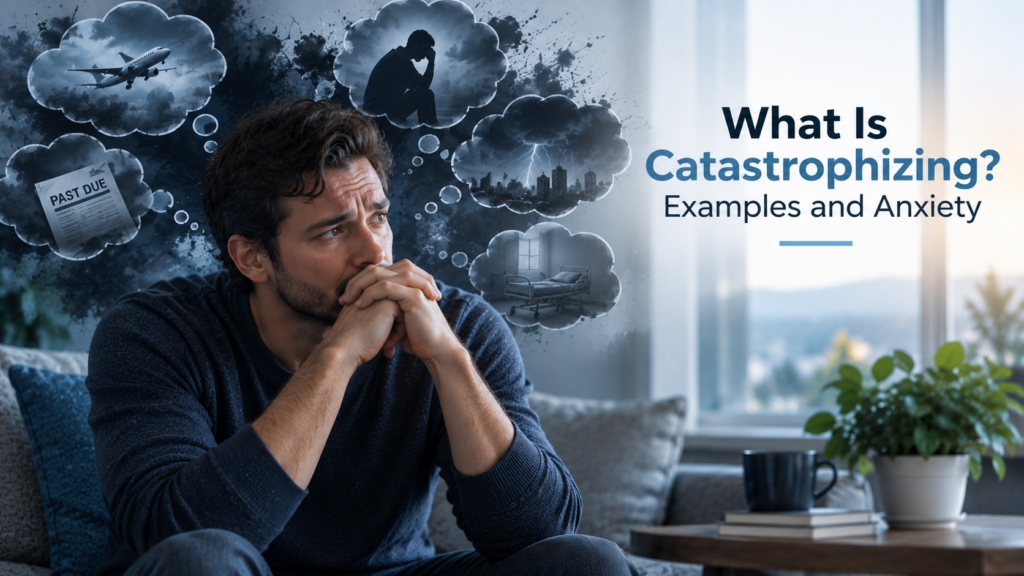
Catastrophizing is a thinking pattern where your mind quickly jumps to the worst possible outcome. A small problem may begin to feel like a major disaster, even when there is little evidence that something terrible will happen.
For some people, this pattern may become stronger after stressful or painful experiences. Understanding how thoughts, fear, and the nervous system connect can be an important part of trauma therapy in Orange County.
Catastrophizing can increase anxiety, fear, stress, and physical symptoms. Learning how to recognize these thoughts can make them easier to challenge.
What Is Catastrophizing?
Catastrophizing means expecting a situation to turn out much worse than it probably will.
A person may take one possible problem and imagine the most frightening result. Their mind may treat that outcome as if it is almost certain to happen.
For example, someone may make a small mistake at work and immediately think:
“I am going to get fired.”
That thought may then grow into:
“I will lose my income, lose my home, and everything will fall apart.”
The original problem was one mistake. Catastrophic thinking turned it into a chain of worst-case scenarios.
Catastrophizing does not mean a person is choosing to be dramatic. In many cases, the thought happens quickly and automatically.
Is Catastrophizing a Cognitive Distortion?
Catastrophizing is often described as a cognitive distortion.
A cognitive distortion is a thought pattern that can cause a person to view a situation in an inaccurate or overly negative way.
These thoughts may feel completely true in the moment. However, feelings and thoughts are not always the same as facts.
Catastrophic thinking often includes two main patterns:
Predicting the Worst Outcome
A person assumes that the worst possible result will happen.
For example:
“I have a headache, so something must be seriously wrong.”
There may be many harmless reasons for the headache, but the mind focuses on the most frightening possibility.
Believing You Cannot Handle the Outcome
Catastrophizing can also make a person believe that a difficult situation would be impossible to manage.
For example:
“If I fail this test, my entire future will be ruined.”
Failing a test may be disappointing, but it usually does not determine a person’s entire future.
What Are Common Examples of Catastrophizing?
Catastrophizing can happen in many parts of daily life. It may affect work, relationships, school, health, money, or social situations.
Catastrophizing About Health
A person notices a physical symptom and immediately assumes it means something serious.
For example:
“My chest feels tight. I must be having a medical emergency.”
Anxiety itself can cause physical symptoms such as muscle tension, fast breathing, sweating, and a racing heart. However, new or severe physical symptoms should still be evaluated by a medical professional when appropriate.
Catastrophizing in Relationships
Someone may receive a short text from their partner and think:
“They are angry with me. They are probably going to leave.”
There may be many other explanations. The person could be busy, tired, or distracted.
Catastrophizing at Work
A person makes a mistake and thinks:
“My boss will find out. I will get fired. I will never find another job.”
This thought moves from one problem to several extreme predictions without enough evidence.
Catastrophizing in Social Situations
Someone may worry before attending an event:
“I am going to say something embarrassing. Everyone will judge me. Nobody will want to talk to me again.”
This can cause strong anticipatory anxiety before anything has actually happened.
Catastrophizing About Money
A person receives an unexpected bill and thinks:
“I will never recover financially.”
The bill may create real stress, but catastrophic thinking can make the situation seem permanent and impossible to solve.
How Does Catastrophizing Affect Anxiety?
Catastrophizing and anxiety can strengthen each other.
An anxious thought creates fear. Fear may cause uncomfortable physical sensations. Those sensations may then seem like proof that something bad is happening.
The cycle may look like this:
A stressful event happens.
You imagine the worst possible outcome.
Your anxiety rises.
Your body reacts to the fear.
You notice the physical symptoms.
You become even more worried.
The catastrophic thought feels more believable.
This cycle can continue until the mind and body both feel overwhelmed.
What Does Catastrophizing Feel Like?
Catastrophic thinking can feel very real.
A person may know on some level that their fear is unlikely, yet still feel unable to stop thinking about it.
Common experiences may include:
- Constant thoughts about what could go wrong
- Feeling unable to stop worrying
- Replaying possible negative outcomes
- Trouble concentrating
- Difficulty sleeping
- Feeling restless or tense
- A racing heartbeat
- Muscle tension
- Stomach discomfort
- Feeling overwhelmed by small problems
- Seeking frequent reassurance from others
Catastrophizing may also cause a person to avoid situations that they believe could go badly.
Why Do People Catastrophize?
There is rarely one single cause of catastrophizing.
Several factors may play a role.
Anxiety
People who experience ongoing anxiety may pay more attention to possible threats.
The brain may repeatedly ask:
“What if something goes wrong?”
This can make worst-case thinking feel like a way of preparing for danger.
Past Stressful Experiences
Difficult or frightening experiences may change how a person responds to uncertainty.
Someone who has experienced unexpected problems in the past may become highly alert to signs that another problem could happen.
Fear of Uncertainty
Some people have a hard time not knowing what will happen next.
The mind may try to fill in missing information. Unfortunately, anxiety often fills those gaps with negative possibilities.
Learned Thinking Patterns
Catastrophic thinking can become a habit.
If someone has responded to stress this way for years, the thought process may happen automatically before they even notice it.
Can Trauma Cause Catastrophic Thinking?
Trauma may contribute to catastrophic thinking in some people.
After a frightening or painful event, the nervous system may become more sensitive to possible danger. A person may scan their surroundings or thoughts for warning signs.
This can make harmless situations feel threatening.
For example, someone who has experienced a serious car accident may feel intense anxiety when another driver suddenly brakes.
Their mind might immediately think:
“We are going to crash.”
The brain may be trying to protect the person based on past experience, even when the current situation is safe.
What Is the Difference Between Catastrophizing and Normal Worry?
Everyone worries sometimes.
Normal worry usually stays connected to a realistic problem.
Catastrophizing takes worry further.
For example, normal worry might sound like:
“I am worried I did poorly on my test.”
Catastrophic thinking might sound like:
“I failed the test. I am going to fail the class. I will never graduate. My future is ruined.”
The difference is the jump from one possible problem to a chain of extreme conclusions.
Can Catastrophizing Cause Panic Attacks?
Catastrophic thoughts may contribute to panic symptoms in some people.
A physical sensation such as dizziness or a racing heartbeat may trigger a frightening thought.
For example:
“My heart is beating fast. Something terrible is happening.”
The fear increases adrenaline and other stress responses. The heart may beat even faster, which can make the person more afraid.
This does not mean catastrophizing causes every panic attack. Panic symptoms can have many causes. However, learning to challenge frightening interpretations may help some people reduce the anxiety cycle.
How Can You Stop Catastrophizing?
It may not be possible to stop every negative thought from appearing. The goal is often to notice the thought and respond to it differently.
Identify the Catastrophic Thought
Start by naming what is happening.
You might say:
“I am having a catastrophic thought.”
This creates some distance between you and the fear.
Instead of thinking:
“This terrible thing will happen,”
you can recognize:
“My mind is predicting that this terrible thing will happen.”
That small change can make the thought easier to examine.
Ask What Evidence You Have
Look at the facts.
Ask yourself:
- What evidence supports this thought?
- What evidence does not support it?
- Am I assuming I know what will happen?
- Is there another possible explanation?
Try to separate facts from predictions.
Consider the Most Likely Outcome
Anxiety often focuses on the worst possible outcome rather than the most likely one.
Ask:
“What is realistically most likely to happen?”
For example, instead of:
“I made a mistake, so I will lose my job,”
a more balanced thought might be:
“I made a mistake. I can correct it and learn from it.”
Ask Yourself What You Would Do
Another helpful question is:
“If something difficult did happen, what could I do next?”
This can reduce the belief that a bad outcome would be impossible to handle.
You may have more coping skills, resources, and support than anxiety allows you to see in the moment.
How Does Cognitive Behavioral Therapy Help Catastrophizing?
Cognitive behavioral therapy, often called CBT, is one approach used to address unhelpful thinking patterns.
CBT can help people notice automatic thoughts and examine whether those thoughts are accurate or useful.
A person may learn to replace an extreme thought with a more balanced one.
For example:
Catastrophic thought:
“I embarrassed myself. Everyone thinks I am stupid.”
Balanced thought:
“I felt embarrassed, but one awkward moment does not tell me what everyone thinks about me.”
The goal is not to force positive thinking. The goal is to develop a more realistic view of the situation.
What Are Helpful Grounding Skills for Catastrophic Thinking?
When anxiety becomes intense, calming the body may make thoughts easier to manage.
Slow Your Breathing
Try taking slow, comfortable breaths.
Focus on making the exhale slightly longer than the inhale.
Avoid forcing very deep breaths if that makes you dizzy or uncomfortable.
Focus on Your Surroundings
Name things you can see, hear, touch, or smell.
This can help bring attention away from imagined future problems and back to the present moment.
Write Down the Thought
Seeing the thought on paper may make it easier to examine.
Write down:
- What happened
- What you thought would happen
- What you felt
- What evidence supports the thought
- What evidence challenges it
- A more balanced explanation
Over time, this can help identify repeated thinking patterns.
When Should You Get Help for Catastrophizing?
Occasional worst-case thinking is common.
Professional support may be helpful when catastrophizing begins to interfere with daily life.
Consider speaking with a mental health professional if worry regularly affects:
- Sleep
- Work
- School
- Relationships
- Physical health
- Concentration
- Daily responsibilities
- Your ability to leave home or attend activities
Treatment may focus on anxiety, trauma, stress management, emotional regulation, or other concerns connected to the thought pattern.
Revival Mental Health provides mental health treatment for people who need additional support managing anxiety, trauma-related symptoms, and patterns of distressing thoughts.
Learning to Respond Differently to Catastrophic Thoughts
Catastrophizing can make a small problem feel like a life-changing disaster.
The thoughts may feel powerful, but they are still thoughts rather than guaranteed outcomes.
Learning to pause, examine the facts, and consider more realistic possibilities can weaken the cycle between catastrophic thinking and anxiety.
Change usually takes practice. With the right tools and professional support when needed, people can learn to recognize these patterns and respond to uncertainty in healthier ways.
Frequently Asked Questions
Is catastrophizing a symptom of anxiety?
Catastrophizing can occur with anxiety because anxiety often causes people to focus on possible threats and negative outcomes. However, having occasional catastrophic thoughts does not automatically mean someone has an anxiety disorder.
What is an example of catastrophizing?
An example would be making one mistake at work and thinking, “I will get fired, I will never find another job, and my life will fall apart.” The thought jumps from a small event to an extreme outcome without enough evidence.
Why does my brain always think of the worst-case scenario?
The brain naturally looks for possible danger. Stress, anxiety, past experiences, trauma, and fear of uncertainty may make this threat-detection system more active. Over time, worst-case thinking can also become an automatic habit.
Can catastrophizing make anxiety worse?
Yes. Catastrophic thoughts may increase fear and activate the body’s stress response. Physical sensations such as a racing heart or muscle tension can then create more worry, causing a cycle between anxious thoughts and physical symptoms.
How do I break the catastrophizing cycle?
Start by noticing the thought instead of accepting it as a fact. Ask what evidence supports it, what evidence challenges it, and what outcome is most likely. Grounding exercises, slow breathing, writing thoughts down, and therapy may also help.