

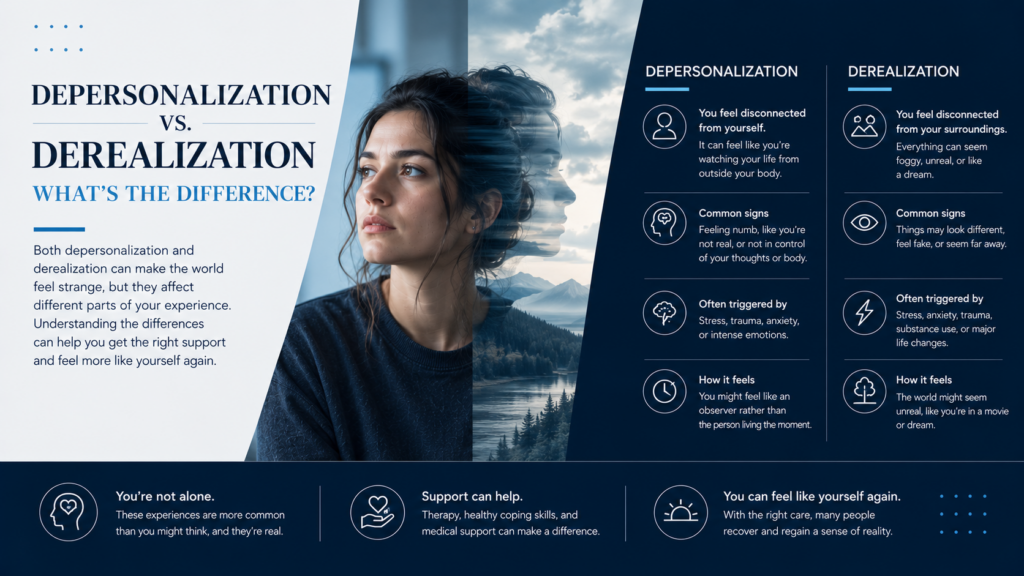
Depersonalization vs derealization can feel confusing because both experiences can make you feel disconnected from normal life. The main difference is simple: depersonalization involves feeling detached from yourself, while derealization involves feeling detached from the world around you.
People dealing with trauma, anxiety, or other mental health concerns may notice these symptoms. Getting the right mental health treatment can help when these feelings become frequent, upsetting, or interfere with daily life.
Understanding which symptoms you are having can make it easier to explain your experience to a mental health professional.
What Is the Difference Between Depersonalization and Derealization?
The difference between depersonalization and derealization is based on what feels unreal or disconnected.
With depersonalization, the disconnected feeling centers on yourself. You may feel separated from your body, thoughts, feelings, or actions.
With derealization, the disconnected feeling centers on your surroundings. The people, places, and objects around you may seem strange, distant, foggy, or dreamlike.
A simple way to remember the difference is:
- Depersonalization: “I do not feel like myself.”
- Derealization: “The world around me does not feel real.”
Some people experience only one of these symptoms. Others experience depersonalization and derealization at the same time.
What Does Depersonalization Feel Like?
Depersonalization is a feeling of being disconnected from your own body, emotions, thoughts, or sense of identity.
You usually know that the feeling is unusual. You may understand that you are still yourself, even though you do not feel fully connected to yourself in that moment.
Common Depersonalization Symptoms
Depersonalization symptoms may include:
- Feeling outside your body
- Feeling like you are watching yourself
- Feeling emotionally disconnected
- Feeling numb or unable to connect with emotions
- Feeling like your body does not belong to you
- Feeling disconnected from your thoughts
- Feeling as if you are moving through life automatically
- Feeling like your voice sounds unfamiliar
- Feeling separated from your memories
Some people describe depersonalization as feeling like they are watching a movie of their own life.
Others may say they understand what they should be feeling but cannot fully feel the emotion.
What Is an Example of Depersonalization?
Imagine you are talking with a friend. You can hear yourself speaking, but suddenly it feels like you are watching the conversation from outside your own body.
You know the conversation is happening. You know you are speaking. But you feel strangely disconnected from yourself.
Another example may happen during an emotional situation. Someone may know they are sad or scared but feel emotionally numb instead of fully experiencing the feeling.
These are examples of depersonalization because the sense of disconnection is focused on the self.
What Does Derealization Feel Like?
Derealization involves feeling disconnected from your environment or the people and objects around you.
You may still understand that your surroundings are real. However, they may not feel normal or familiar.
Common Derealization Symptoms
Derealization symptoms may include:
- Surroundings looking dreamlike
- Familiar places seeming strange
- Feeling like there is a glass wall between you and the world
- Objects looking unusually flat or distant
- Colors seeming brighter or duller than usual
- Sounds seeming far away
- People seeming unfamiliar
- Feeling like the world is foggy
- Feeling like you are inside a dream
- Changes in how you notice distance or size
A familiar bedroom, workplace, or neighborhood may suddenly look unfamiliar even though you know exactly where you are.
What Is an Example of Derealization?
Imagine walking into your home after a stressful day. You recognize your furniture, walls, and family members, but everything suddenly feels strange.
The room may look almost like a movie set. People may seem far away even when they are standing nearby.
You still know that your home is real. The problem is that it temporarily does not feel real.
That experience is closer to derealization because the disconnected feeling involves the outside world.
Depersonalization vs Derealization Symptoms
The easiest way to compare depersonalization vs derealization symptoms is to look at where the sense of detachment occurs.
Depersonalization Focuses on Yourself
Depersonalization may make you feel:
- Detached from your body
- Detached from your emotions
- Detached from your thoughts
- Like you are watching yourself
- Like your actions happen automatically
The main concern is your connection to yourself.
Derealization Focuses on Your Surroundings
Derealization may make you feel:
- Detached from your surroundings
- Like the world looks dreamlike
- Like familiar places seem unfamiliar
- Like people seem distant
- Like objects or sounds seem strange
The main concern is your connection to the outside world.
Can Depersonalization and Derealization Happen Together?
Yes. Depersonalization and derealization can happen at the same time.
A person might feel separated from their body while also feeling like the room around them is unreal.
For example, someone experiencing intense stress might think:
“I feel like I am watching myself, and everything around me looks like a dream.”
The first part describes depersonalization. The second part describes derealization.
Symptoms may last for a short period or return at different times. The experience can vary greatly from one person to another.
What Can Trigger Depersonalization or Derealization?
Several experiences may be connected with depersonalization or derealization symptoms.
Trauma and Severe Stress
Traumatic or highly stressful experiences can sometimes be followed by feelings of depersonalization or derealization.
Symptoms may appear during a stressful event or sometime afterward.
Because these symptoms can occur alongside trauma-related conditions, it is important for a mental health professional to look at the full pattern of symptoms rather than one experience alone.
Anxiety and Panic
High levels of anxiety may also cause feelings of unreality or detachment.
During a panic attack, for example, a person may feel disconnected from their body or believe the room around them suddenly looks strange.
These symptoms can increase fear because the person may not understand what is happening.
Lack of Sleep and Exhaustion
Severe sleep loss and physical exhaustion can sometimes make a person feel disconnected or mentally foggy.
Sleep problems may also make existing mental health symptoms feel stronger.
Substance Use
Some substances can cause temporary changes in perception, thoughts, emotions, or awareness.
A mental health professional should know about alcohol, cannabis, recreational drugs, medications, and other substances when evaluating new symptoms.
Are Depersonalization and Derealization the Same as Psychosis?
Depersonalization and derealization are not automatically signs of psychosis.
A major difference is often a person’s awareness of what is happening.
Someone experiencing derealization may say:
“My surroundings feel unreal, but I know they are actually real.”
A person experiencing depersonalization may say:
“I feel like I am outside my body, but I know I am really here.”
That awareness can help mental health professionals understand the experience.
However, symptoms involving major changes in perception, reality, thinking, or behavior should be evaluated by a qualified professional. Different mental health conditions can sometimes share similar symptoms.
How Long Can Depersonalization or Derealization Last?
The length of depersonalization or derealization symptoms can vary.
For some people, symptoms may last only a few minutes.
Other people may experience episodes lasting hours or longer. Symptoms may also disappear and return during stressful periods.
Occasional brief symptoms do not always mean that someone has a mental health disorder.
However, repeated or long-lasting symptoms may need professional evaluation, especially when they make it difficult to work, attend school, maintain relationships, sleep, or complete daily activities.
When Should You Get Help for Depersonalization or Derealization?
Consider talking with a mental health professional when depersonalization or derealization:
- Happens often
- Lasts for long periods
- Causes strong fear or distress
- Makes it hard to work or study
- Affects your relationships
- Makes it difficult to care for yourself
- Happens along with severe anxiety
- Begins after trauma
- Becomes difficult to control
- Causes you to avoid normal activities
Professional support can help identify possible triggers and determine whether another mental health condition may be contributing to the symptoms.
How Are Depersonalization and Derealization Evaluated?
There is no single test that explains every episode of depersonalization or derealization.
A mental health professional may ask questions about:
- What the symptoms feel like
- When they started
- How often they occur
- How long episodes last
- Trauma history
- Anxiety symptoms
- Panic attacks
- Sleep
- Medication use
- Alcohol or drug use
- Other mental health symptoms
A medical evaluation may also be appropriate in some cases to help rule out physical or medication-related causes.
Giving clear examples can help.
For example, saying, “I feel like I am watching myself from outside my body” gives more useful information than simply saying, “I feel weird.”
Can Depersonalization and Derealization Be Treated?
Treatment depends on what is causing or contributing to the symptoms.
Therapy
Therapy may help people understand triggers, manage distress, and respond differently when symptoms appear.
Treatment may also address trauma, anxiety, panic attacks, depression, or other concerns that occur with depersonalization or derealization.
Grounding Skills
A therapist may teach grounding skills that help bring attention back to the present moment.
Examples may include noticing physical sensations, naming objects in the room, listening closely to sounds, or paying attention to breathing.
These strategies do not replace professional treatment, but they may help some people feel more connected during an episode.
Treating Related Mental Health Conditions
If anxiety, trauma, depression, panic attacks, or another condition is contributing to symptoms, treating that condition may reduce how often depersonalization or derealization occurs.
Treatment should be based on a person’s individual symptoms and needs.
What Should You Do During an Episode?
When depersonalization or derealization happens, remind yourself that the feeling can be frightening without meaning that you are permanently losing touch with yourself or your surroundings.
You may try:
- Naming five things you can see
- Feeling your feet against the floor
- Holding a cool object
- Listening to sounds around you
- Taking slow breaths
- Talking to someone you trust
- Reminding yourself where you are
- Avoiding alcohol or recreational drugs
- Getting rest when possible
If episodes continue, speak with a mental health professional rather than relying only on self-help strategies.
Depersonalization vs Derealization: The Key Difference
The key difference between depersonalization vs derealization is where the feeling of disconnection occurs.
Depersonalization affects your connection with yourself. You might feel outside your body, emotionally disconnected, or like you are watching yourself.
Derealization affects your connection with your surroundings. The world may seem dreamlike, distant, strange, or unfamiliar.
Both experiences can occur during periods of stress, trauma, anxiety, panic, or other mental health concerns.
If you want a broader explanation of disconnected or detached experiences, read “What Does Dissociation Feel Like?” That article can cover the wider topic without confusing it with the specific depersonalization vs derealization comparison.
When these symptoms become frequent or interfere with everyday life, professional mental health support may help identify what is happening and what type of treatment may be appropriate.
Revival Mental Health provides support for people experiencing trauma-related and other mental health symptoms. A professional evaluation can help determine whether depersonalization, derealization, anxiety, trauma, or another condition may be contributing to your experience.
Frequently Asked Questions
What is the main difference between depersonalization and derealization?
Depersonalization involves feeling disconnected from yourself. Derealization involves feeling disconnected from your surroundings. A person with depersonalization may feel like they are watching themselves, while someone experiencing derealization may feel like the world looks dreamlike or unreal.
Can you have depersonalization without derealization?
Yes. Some people experience only depersonalization symptoms. Others experience only derealization symptoms. It is also possible to experience both at the same time.
Is feeling outside your body depersonalization or derealization?
Feeling outside your body or like you are watching yourself is more closely connected with depersonalization. Depersonalization affects your sense of connection to your body, thoughts, emotions, or identity.
Is feeling like the world is a dream derealization?
Yes. Feeling like your surroundings are dreamlike, distant, foggy, or strange is a common description of derealization. You may recognize where you are while still feeling as though the environment is somehow unreal.
When should I seek treatment for depersonalization or derealization?
Consider professional support if symptoms happen often, last for long periods, cause severe distress, or interfere with work, school, relationships, sleep, or daily activities. A mental health professional can evaluate possible causes and recommend appropriate treatment.