
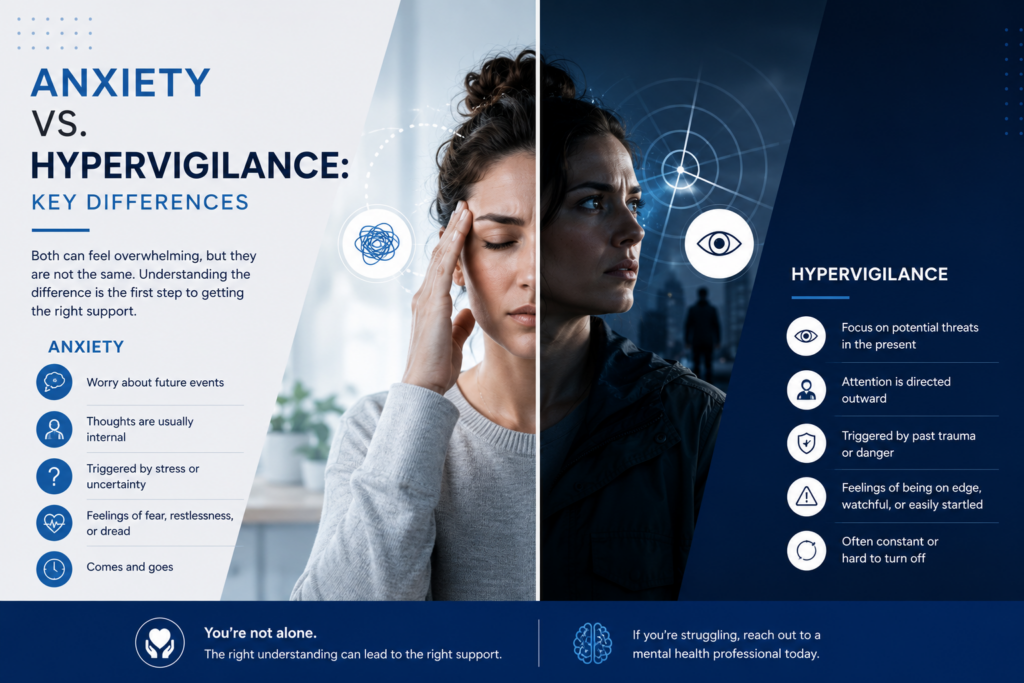
Anxiety vs hypervigilance can be hard to understand because both can make you feel tense, unsafe, and unable to relax. Anxiety often centers on worry about what could go wrong. Hypervigilance involves constantly watching for danger, even when no clear threat is present. It is often tied to trauma or post-traumatic stress disorder (PTSD).
Learning the difference can help you choose the right type of support. Revival Mental Health offers anxiety treatment for people dealing with ongoing worry, fear, panic, and physical anxiety symptoms.
What Is the Main Difference Between Anxiety and Hypervigilance?
The main difference is where the fear comes from and how your body responds.
Anxiety often involves thoughts about possible future problems. You may worry about work, school, health, money, family, or social situations. Your mind may keep asking, “What if something goes wrong?”
Hypervigilance is a state of being highly alert to danger. You may scan rooms, watch people’s movements, notice every sound, or prepare for a threat before there is proof that one exists.
In simple terms:
-
Anxiety says, “Something bad might happen.”
-
Hypervigilance says, “Danger could be here right now.”
-
Anxiety often leads to worry and overthinking.
-
Hypervigilance often leads to threat scanning and a strong startle response.
-
Anxiety can happen without trauma.
-
Hypervigilance is often connected to past trauma, PTSD, or long periods of feeling unsafe.
Both can activate the body’s stress response. However, hypervigilance is more closely tied to the nervous system staying in survival mode.
What Is Anxiety?
Anxiety is a normal response to stress. It can help you prepare for a test, job interview, medical visit, or other hard situation.
Anxiety may become a mental health concern when it is intense, happens often, or interferes with daily life. Anxiety disorders may affect sleep, relationships, school, work, and physical health.
Common anxiety disorders include:
-
Generalized anxiety disorder
-
Panic disorder
-
Social anxiety disorder
-
Specific phobias
-
Separation anxiety disorder
Anxiety does not always have a clear cause. Some people feel anxious even when life seems calm.
What Does Anxiety Feel Like?
Anxiety can affect your thoughts, feelings, body, and actions. Common anxiety symptoms include:
-
Ongoing worry
-
Racing thoughts
-
Fear of making mistakes
-
Trouble making decisions
-
Muscle tension
-
A fast heartbeat
-
Sweating or shaking
-
Shortness of breath
-
Stomach pain or nausea
-
Trouble falling or staying asleep
-
Feeling restless or on edge
-
Avoiding stressful people or places
A person with anxiety may understand that a fear is unlikely but still struggle to stop worrying about it.
The National Institute of Mental Health explains that anxiety disorders involve more than short-term stress or fear. The symptoms may continue and can become worse over time without proper support.
What Is Hypervigilance?
Hypervigilance means being overly alert to possible danger. It can make a person feel as though they must always be ready to protect themselves.
It is not a diagnosis on its own. Instead, it can be a symptom of PTSD, trauma-related stress, anxiety disorders, or other mental health conditions.
Someone who is hypervigilant may enter a room and quickly check:
-
Where the exits are
-
Who is standing nearby
-
Whether anyone looks angry
-
What sounds are coming from outside
-
Whether a door is locked
-
Where they can sit safely
-
How quickly they could leave
This behavior is not simply careful planning. It comes from the nervous system believing that danger may appear at any moment.
What Does Hypervigilance Feel Like?
Hypervigilance can make it hard to feel safe, even in familiar places. Common signs include:
-
Constantly scanning the environment
-
Watching other people closely
-
Feeling unsafe in public
-
Sitting with your back against a wall
-
Checking doors, windows, or locks many times
-
Being easily startled by sounds or movement
-
Feeling unable to lower your guard
-
Having trouble sleeping deeply
-
Becoming tense when someone walks behind you
-
Reading neutral actions as possible threats
-
Feeling irritated or angry without warning
-
Struggling to focus because you are watching for danger
The National Center for PTSD describes feeling highly alert or “on guard” as a common reaction following trauma. Hypervigilance and an exaggerated startle response are also strongly linked with PTSD symptoms.
Anxiety vs Hypervigilance Symptoms
Anxiety and hypervigilance can occur together. Both may cause muscle tension, sleep problems, fear, restlessness, and trouble focusing.
However, several signs can help tell them apart.
Anxiety Often Involves General Worry
Anxiety often focuses on things that could happen later. A person may worry about:
-
Losing a job
-
Getting sick
-
Being judged
-
Failing a test
-
Letting someone down
-
Having a panic attack
-
Making the wrong choice
The worry may move from one topic to another. When one concern improves, the mind may find something new to fear.
Hypervigilance Often Involves Threat Scanning
Hypervigilance is more focused on the immediate environment. A person may search for signs of danger in faces, voices, sounds, doors, crowds, or nearby movement.
For example, a person with general anxiety may worry before attending a party because they fear being judged. A hypervigilant person may spend the party watching the exits, tracking everyone’s location, and jumping whenever a door closes.
Hypervigilance May Cause a Strong Startle Response
A startle response is the body’s automatic reaction to a sudden sound, touch, or movement.
Anyone can jump when they hear a loud noise. With hypervigilance, the reaction may be much stronger. A dropped object, car horn, closing door, or unexpected touch may cause the person to:
-
Jump or freeze
-
Cover their head
-
Become angry
-
Feel their heart race
-
Prepare to run
-
Feel unsafe for several minutes afterward
This response can happen before the person has time to think.
Is Hypervigilance a Form of Anxiety?
Hypervigilance and anxiety are closely connected, but they are not exactly the same.
Hypervigilance can occur as part of an anxiety disorder. For example, a person with panic disorder may constantly watch for changes in their heartbeat or breathing. A person with social anxiety may closely study faces for signs of judgment.
However, hypervigilance is often linked to trauma. After a frightening event, the brain may learn that staying alert is necessary for survival. The danger may be over, but the nervous system may continue acting as though the threat is still present.
PTSD can develop after a person experiences or witnesses a traumatic event. Symptoms may include unwanted memories, avoidance, changes in thoughts and mood, and increased physical arousal.
A person does not need to have PTSD to experience hypervigilance. Only a qualified mental health professional can determine whether symptoms meet the criteria for a specific condition.
How Does Trauma Cause Hypervigilance?
Trauma can change how the brain and body react to stress. During danger, the nervous system activates a survival response.
This may include:
-
Fight: Preparing to defend yourself
-
Flight: Preparing to escape
-
Freeze: Becoming still or unable to act
-
Fawn: Trying to please someone to reduce danger
These responses can protect a person during a true emergency. After trauma, however, the nervous system may become too sensitive.
A facial expression, smell, sound, location, or tone of voice may remind the brain of the traumatic event. This reminder is called a trauma trigger. The body may react as though the past danger is happening again.
What Is Nervous-System Activation?
Nervous-system activation happens when the body prepares to handle a threat. Stress hormones may increase, the heart may beat faster, and muscles may tighten.
During hypervigilance, this activation may happen often or remain active for long periods. The person may feel physically unable to relax.
Possible signs include:
-
Rapid breathing
-
Chest tightness
-
Sweating
-
Shaking
-
Jaw clenching
-
Headaches
-
Stomach problems
-
Feeling hot or cold
-
Trouble sleeping
-
Feeling disconnected from the present
This reaction is not a personal failure. It is the body trying to provide protection based on what it learned from past danger.
Can You Have Anxiety and Hypervigilance at the Same Time?
Yes. Anxiety and hypervigilance often overlap.
A person may have general worry while also watching for immediate threats. For example, someone may worry all day about safety and then check every noise at night.
The conditions can also make each other worse. Hypervigilance may cause a person to notice harmless sounds or movements. Anxiety may then lead the person to believe those signs mean something bad will happen.
This cycle may look like this:
-
The person notices a sound.
-
The nervous system becomes activated.
-
The person searches for danger.
-
The mind creates a frightening explanation.
-
Anxiety increases.
-
The person becomes even more alert.
Over time, this cycle may lead to exhaustion, sleep loss, avoidance, irritability, and relationship problems.
Is Hypervigilance Always Caused by PTSD?
No. Hypervigilance does not always mean someone has PTSD.
It may appear with:
-
Anxiety disorders
-
Panic disorder
-
Past abuse or neglect
-
Ongoing stress
-
Unsafe living conditions
-
Sleep loss
-
Trauma-related disorders
-
Certain medical conditions
-
Some medications or substances
Hypervigilance can also be a reasonable response when a person is in real danger. The concern comes when the body remains on high alert after the threat has passed or when the response disrupts everyday life.
A full assessment can help identify whether symptoms are connected to anxiety, PTSD, trauma, another condition, or more than one concern.
How Are Anxiety and Hypervigilance Diagnosed?
There is no single medical test that can prove a person has anxiety or hypervigilance.
A licensed mental health professional may ask about:
-
Current symptoms
-
Past traumatic events
-
When the symptoms began
-
Common triggers
-
Sleep habits
-
Panic attacks
-
Avoidance behaviors
-
Physical health
-
Medication or substance use
-
Effects on work and relationships
The provider may also screen for anxiety disorders, PTSD, depression, and other conditions.
It is important to be open about trauma symptoms, even when they are hard to discuss. A trauma-informed provider should move at a safe pace. You should not be forced to share every detail before you are ready.
What Treatments Help Anxiety and Hypervigilance?
Treatment depends on the cause, type, and severity of the symptoms. A person with general anxiety may need a different plan than someone whose hypervigilance began after trauma.
Cognitive Behavioral Therapy
Cognitive behavioral therapy, or CBT, helps people notice how thoughts, feelings, and behaviors affect each other.
For anxiety, CBT may help challenge fearful predictions and reduce avoidance. For trauma-related hypervigilance, it may help a person understand triggers and develop safer responses.
Exposure-Based Therapy
Exposure therapy helps a person face feared situations in a planned and gradual way. The goal is not to force someone into distress. It is to teach the brain that certain situations can be handled safely.
Exposure-based methods should be guided by a trained professional, especially when trauma is involved.
EMDR Therapy
Eye movement desensitization and reprocessing, or EMDR, is often used for trauma and PTSD. It may help the brain process painful memories so they feel less immediate and powerful.
People with trauma symptoms can learn more about trauma therapy and how treatment may help the nervous system build a stronger sense of safety.
PTSD Treatment
When hypervigilance is part of PTSD, treatment may also address nightmares, flashbacks, avoidance, emotional numbness, anger, and negative beliefs.
Revival Mental Health provides PTSD treatment using personalized, trauma-informed support.
Medication
Medication may help reduce anxiety, panic, sleep problems, or other symptoms for some people. A licensed medical provider should review the person’s symptoms, health history, current medications, and possible risks before recommending medication.
Medication often works best as one part of a complete treatment plan.
How Can You Calm Hypervigilance in the Moment?
Grounding skills may help remind the nervous system that you are in the present.
Try these steps:
-
Place both feet on the floor.
-
Slowly breathe out longer than you breathe in.
-
Name five things you can see.
-
Name four things you can feel.
-
Name three sounds you can hear.
-
Remind yourself of your name, location, and the current date.
-
Say, “I feel alarmed, but I am safe right now.”
Other helpful actions may include stretching, walking, holding a cold object, lowering background noise, or moving to a calm space.
Grounding does not replace professional treatment, but it may lower nervous-system activation in the moment.
When Should You Seek Professional Help?
Consider speaking with a mental health professional when anxiety or hypervigilance:
-
Happens most days
-
Keeps you from sleeping
-
Causes panic attacks
-
Makes you avoid normal activities
-
Harms your relationships
-
Affects work or school
-
Leads to anger or frequent conflict
-
Causes you to use substances to cope
-
Makes you feel unsafe when no danger is present
-
Continues after a traumatic event
Seek urgent help when symptoms create an immediate risk of harm to yourself or another person.
How Revival Mental Health Can Help
Understanding anxiety vs hypervigilance is an important first step, but you do not have to determine the cause on your own.
Revival Mental Health can assess your symptoms, trauma history, triggers, sleep, physical reactions, and daily challenges. Your care plan may include individual therapy, group support, trauma-focused treatment, coping skills, medication management, or other evidence-based services.
The goal is not to remove every normal stress response. Treatment can help your brain and body tell the difference between a real threat and a reminder of past danger. With the right care, it is possible to feel safer, sleep better, reduce fear, and regain control of daily life.
Frequently Asked Questions
What is the biggest difference between anxiety and hypervigilance?
Anxiety often involves worry about what might happen in the future. Hypervigilance involves closely watching the present environment for possible danger. Hypervigilance may include threat scanning, checking exits, watching people, and reacting strongly to sudden sounds.
Can anxiety cause hypervigilance?
Yes. Severe anxiety can make a person more alert to possible problems or body sensations. However, hypervigilance is also commonly connected to trauma and PTSD. A professional assessment can help identify the main cause.
Is hypervigilance a symptom of PTSD?
Hypervigilance can be a symptom of PTSD, especially when it begins after a traumatic event. Other PTSD symptoms may include flashbacks, nightmares, avoiding reminders, emotional changes, sleep problems, and an exaggerated startle response.
How do I know whether I have anxiety or trauma?
Think about when the symptoms began and what triggers them. General worry about many areas of life may point toward anxiety. Threat scanning, trauma reminders, nightmares, or feeling unsafe after a frightening event may suggest trauma-related symptoms. Only a qualified professional can provide a diagnosis.
Can hypervigilance go away?
Yes. Hypervigilance can improve with trauma-informed treatment, coping skills, better sleep, nervous-system regulation, and support. Progress may take time because the brain must learn that it does not need to stay in survival mode all day.